
Global textile finishing facilities operate under intense pressure from rising energy tariffs, fluctuating raw material costs, and stringent buyer specifications. Operating margins leave zero room for mechanical inefficiency or inconsistent product quality. Manual interventions and legacy equipment create compounding defect rates, forcing manufacturers into a cycle of reactive quality control rather than proactive assurance. The structural reality of the market dictates that profitability can only be sustained through highly synchronized, continuous production environments.
The traditional approach to maintaining a production line relies heavily on reactive maintenance and subjective operator adjustments. Unplanned downtime and mechanical degradation generate severe financial bleeding, far beyond the direct loss of immediate production. When a slitting machine or hemming line halts unexpectedly, the facility absorbs the costs of idle labor, premium-priced emergency replacement parts, and scrapped fabric batches. These disruptions systematically erode profitability and damage vendor relationships through delayed shipment penalties.
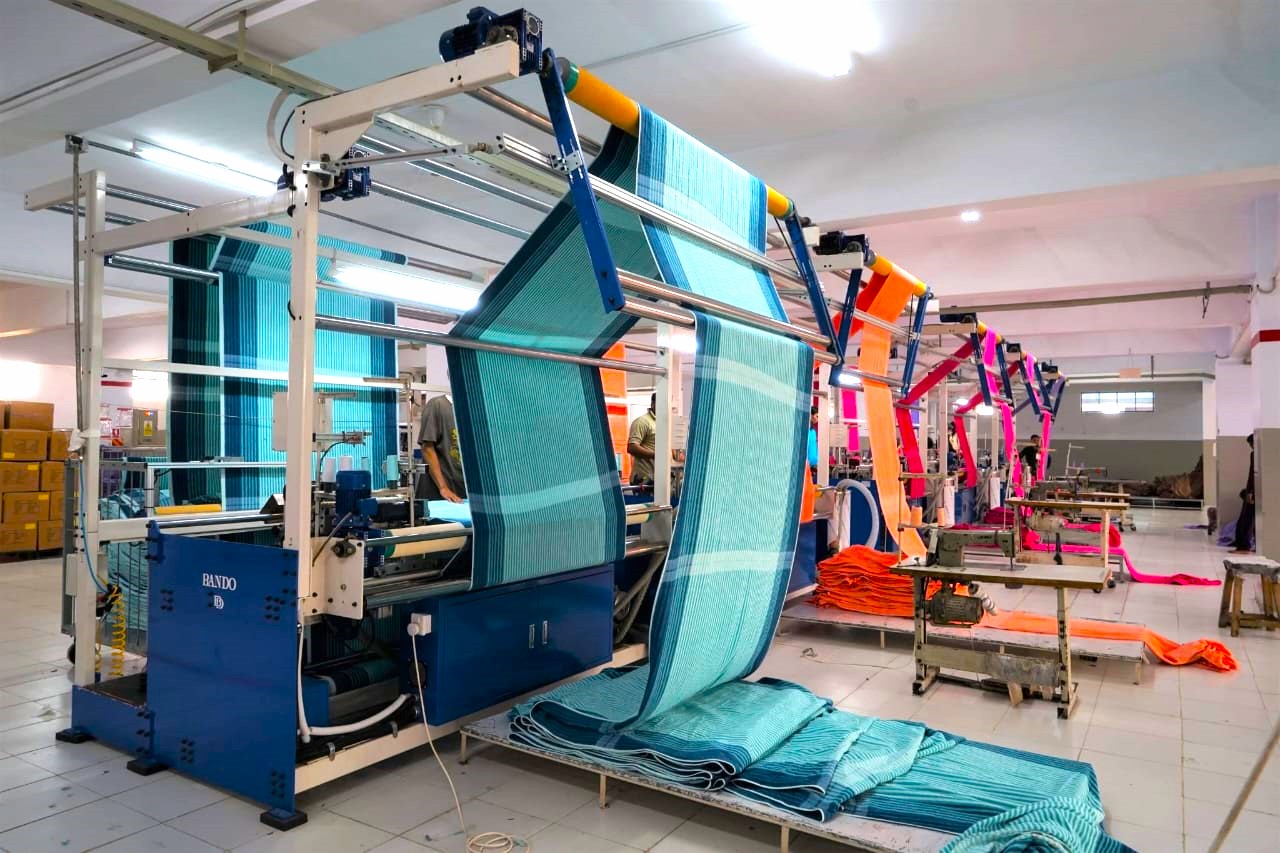
Overcoming these operational bottlenecks requires a structural shift from manual material handling to interconnected machine control. Implementing Towel Automation addresses the root causes of fabric waste and inconsistent edge quality. This systematic upgrade replaces subjective human tension adjustments with precision servo motors and algorithmic cutting control, ensuring that continuous woven rolls are converted into finalized units without interrupting the broader manufacturing workflow.
Continuous operation at scale demands machinery that can self-regulate and log data without pausing. By utilizing advanced sensors and programmable logic controllers, modern facilities stabilize critical production variables such as pile height, stitch density, and exact cutting lengths. Real-time data capture enables predictive maintenance protocols, allowing engineering teams to identify worn slitting blades or degrading sewing heads before they trigger a catastrophic line failure.
Integrating these high-performance systems creates a seamless workflow from the weaving shed to the final packaging bay. Utilizing customized industrial textile equipment ensures that individual units communicate effectively within the facility’s overarching digital architecture. The result is a unified production floor capable of executing complex, high-volume orders with minimal dimensional variance and superior energy efficiency.
The Financial Mechanics of Unplanned Downtime
The cost of equipment failure in a textile manufacturing environment extends far beyond the price of a replacement part. For the average industrial plant, unplanned downtime results in approximately 800 hours of lost production annually. In financial terms, these unscheduled interruptions cost roughly 35% more per minute than planned maintenance. The distinction is critical: scheduled maintenance allows a facility to throttle production strategically, whereas an unexpected failure triggers a cascade of expensive, immediate reactions.
A primary driver of this financial drain is the emergency repair premium. Reactive repairs typically cost three to five times more than the exact same work performed on a schedule due to expedited shipping fees, after-hours technician callouts, and overtime labor. Furthermore, equipment failure is rarely random. Data indicates that aging machinery and a lack of condition monitoring drive nearly half of all unplanned stoppages, while human error in manual setups accounts for a substantial secondary percentage.
When a traditional finishing line stops mid-cycle, the materials currently in process—often already bleached and dyed—are frequently subjected to uneven tension or prolonged heat exposure, rendering them as scrap. By transitioning to data-driven equipment, manufacturers can monitor motor torque, blade alignment, and vibration levels in real time, shifting their operational model from reactive crisis management to predictive efficiency.
| Downtime Cost Category | Financial Impact Mechanism | Escalation Factor |
| Direct Production Loss | Value of units not manufactured during the stoppage | 100% of hourly revenue capacity |
| Emergency Parts Premium | Rush-ordered replacement components | Costs typically 40% higher than planned procurement |
| Idle and Overtime Labor | Workers paid during non-productive hours, plus catch-up overtime | Overtime paid at 1.5x to 2x standard labor rates |
| Scrapped Material | Mid-process fabric ruined by sudden tension loss or heat | Loss of raw material and accumulated chemical processing costs |
| Contract Penalties | Fines for failing to meet Service Level Agreements (SLAs) | Compounding per-day late fees and eroded vendor trust |
High-Velocity Fabric Slitting and Hemming Execution
Replacing manual or semi-automated cutting stations with high-performance automated lines drastically reduces labor dependency while stabilizing output quality. The integration of advanced machinery provides a measurable advantage in sheer throughput and dimensional accuracy.
Precision Slitting Operations
The initial conversion of jumbo rolls into functional widths requires flawless execution. Systems engineered for high-speed efficiency process materials at velocities between 30 and 50 meters per minute. Operating at this speed demands immense kinematic stability to prevent burr formation, material curling, or uneven edge quality—defects that frequently occur when manual blades deflect under pressure.
Automated length measurement and closed-loop tension control ensure uniform widths across continuous production runs. If the unwind tension is inconsistent, the fabric memory will cause the material to curl post-slitting, severely disrupting downstream hemming stations. By utilizing advanced web guiding sensors and precisely calibrated blade clearances, modern slitting machines mitigate the risk of processing jams and dust accumulation.
High-Speed Longitudinal and Cross Hemming
Once slit, the fabric feeds directly into longitudinal hemming systems. Utilizing advanced Japanese sewing heads and inverter-driven PLC controls, premium equipment operates continuously at 20 meters per minute while maintaining a strict density of eight stitches per inch. A critical engineering feature in these machines is the deployment of keyboard-type pressers. These pneumatic clamps mechanically absorb the height differences between flat woven borders and dense terry piles, preventing the fabric from shifting laterally and ensuring a perfectly straight, uniform hem.
The conversion of continuous rolls into individual pieces remains the most complex phase of finishing. Automated cross-cutting modules leverage optical sensors to process 7 to 12 pieces per minute. By accurately detecting the precise transition zones in the terry fabric, the machine executes clean transverse cuts that minimize material waste and guarantee exact retail dimensions.
| Processing Stage | Target Velocity | Critical Engineering Requirement |
| Auto Length Slitting | 30 – 50 m/min | Web edge guiding, dynamic tension calibration, vibration dampening |
| Auto Length Hemming | Up to 20 m/min | Keyboard-type pressers, high-speed Japanese sewing heads, continuous feed |
| Auto Cross Cutting | 7 – 12 pcs/min | Optical pile transition detection, automated length measurement |
Mitigating GSM Variance and the “Heavy Towel” Syndrome
In the competitive textile export market, Grams per Square Meter (GSM) is the absolute metric for fabric density, thickness, and material cost. Standard household products typically range from 400 to 600 GSM, while premium hospitality goods require a dense 600 to 900 GSM.
Traditional mechanical looms and semi-automated cutting lines rely on manual tension settings that inevitably drift over a prolonged shift. This mechanical drift frequently results in a 3% to 5% weight variance. If a manufacturer aims for a 500 GSM specification but produces a 520 GSM product due to tension drift, they are effectively giving away free yarn on every single unit—a phenomenon recognized industry-wide as the “heavy towel” syndrome. Conversely, producing an underweight towel triggers immediate buyer rejections and costly rework.
Modern automation eradicates this variance. By utilizing closed-loop feedback systems and servo-driven pile control, the machinery constantly monitors and adjusts the warp let-off and fabric take-up speeds. This ensures that the exact loop length and pile density remain mathematically consistent across millions of production cycles. Furthermore, precision cross-hemming machinery relies on this uniformity; a fabric with fluctuating GSM will feed unevenly through a folding and stitching mechanism, causing needle breakage, motor strain, and jagged hems.
| GSM Range | End-User Application | Technical Manufacturing Challenge |
| 300 – 400 | Utility, athletic, and travel textiles | High fraying risk; requires extremely precise edge sealing and cutting |
| 400 – 600 | Standard household bath and beach textiles | Balancing optimal absorbency with drying speed; requires strict weight control |
| 600 – 900 | Luxury hospitality and premium retail | Extended industrial drying times; demands heavy-duty sewing head penetration |
The Automation Control Layer and Energy Economics
Hardware is only as effective as the control architecture driving it. The integration of programmable logic controllers, sophisticated human-machine interfaces, and variable frequency drives defines modern textile efficiency. This is particularly critical in regions facing volatile energy tariffs, where industrial electricity rates can exceed 13 cents per kilowatt-hour, creating a severe cost disadvantage against regional competitors.
Traditional fixed-speed motors draw maximum current regardless of the actual mechanical load required at a specific millisecond, generating wasted heat and excessive mechanical wear. Integrating variable frequency drives ensures that the motor speed precisely matches the immediate task demand. During off-peak cycles or lighter fabric runs, these drives automatically throttle energy consumption, yielding verified power reductions of 15% to 40% across spinning, weaving, and finishing departments.
By standardizing on robust control architectures, facilities achieve microsecond precision over their moving parts. These systems enable seamless integration with Supervisory Control and Data Acquisition networks, allowing floor managers to monitor live performance data, diagnose potential sensor faults, and optimize blade tension without stopping the line.
Advanced logic controllers manage everything from simple conveyor timing to complex, multi-axis robotic fabric folding. When a line detects a fault—such as a dropped stitch or a misaligned fabric edge—AI-driven visual inspection systems halt the machinery in milliseconds, preventing the subsequent processing of defective material. This transition from blind mechanical operation to intelligent, data-driven manufacturing represents the only sustainable path forward for large-scale textile processors.
Overcoming Global Supply Chain and Labor Constraints
The textile industry currently faces a severe shortage of skilled manual labor, paired with an increasing demand for rapid production cycles. Fast fashion and accelerated retail turnover require lead times to shrink by 20% to 30%. Relying on manual fabric handling, manual edge alignment, and visual inspection is no longer mathematically viable for fulfilling bulk international orders.
Implementing comprehensive cutting and sewing automation drastically alters a facility’s labor economics. By automating the most physically demanding and repetitive tasks, factories reduce their dependency on manual labor by up to 40%. This allows management to reallocate their workforce to high-value technical roles, such as machine programming, quality assurance, and predictive maintenance monitoring.
Simultaneously, error rates plummet. Automated systems do not suffer from fatigue, ensuring that the first cut of a twelve-hour shift is identical to the last. For facilities operating on thin margins, the reduction in defect rates from an average of 10% down to under 3% provides an immediate return on investment. The ability to guarantee flawless, repeatable quality at high volumes transforms a facility from a basic supplier into a trusted global manufacturing partner.
Frequently Asked Questions
What physical mechanisms cause burr formation during fabric slitting? Burr formation and uneven edges are primarily caused by dull slitting blades, improper blade alignment, or excessive cutting pressure. When blades lose their edge, they drag and tear the fabric rather than slicing it cleanly. Maintaining strict blade replacement schedules and utilizing automated tension control resolves these defects.
How does precise Grams per Square Meter (GSM) control impact factory profitability? GSM measures fabric density. Manual tension drift often results in a 3-5% weight variance. If towels are produced heavier than specified, the manufacturer wastes raw material, effectively giving away free yarn. Automated pile control and tensioning systems eliminate this variance, protecting tight profit margins.
What defines the “heavy towel” syndrome in textile manufacturing? The “heavy towel” syndrome occurs when mechanical drift in legacy looms causes the pile loops to be woven slightly longer or denser than the target specification. This results in a product that weighs more than required, consuming excess costly raw materials without increasing the selling price of the final unit.
How do variable frequency drives reduce energy consumption in finishing lines? Variable frequency drives dynamically adjust the electrical power supplied to a motor based on the exact mechanical load required. Unlike traditional fixed-speed motors that constantly run at full power, these drives throttle energy usage during lighter tasks, lowering electrical costs by up to 40% while reducing mechanical wear.
What is the operational advantage of Japanese sewing heads in hemming equipment? Japanese sewing heads are engineered for extreme durability and precision under high-speed, continuous loads. In automated hemming machinery, they allow the system to reliably execute tight stitch densities at speeds of up to 20 meters per minute without suffering from thread breakage or skipped stitches.
How do automated cross-cutting systems manage the transition between flat weaves and terry piles? Advanced cross-cutting and hemming machines utilize specialized keyboard-type pressers and pneumatic clamps. These components physically absorb the height differences between flat woven borders and thick terry loops, ensuring the fabric remains flat and does not shift laterally while passing through the cutting blades.
Why does unplanned downtime carry a higher financial penalty than scheduled maintenance? Unplanned downtime triggers premium emergency repair costs, including expedited shipping for replacement parts and after-hours labor rates. Additionally, sudden stoppages often ruin the materials currently being processed and result in missed delivery deadlines, which can incur severe contract penalties from buyers.
What specific data streams do programmable logic controllers track during fabric processing? A modern programmable logic controller logs real-time data on processing speed, cut count, length variance, motor torque, operating temperature, and error events. This data is fed into central monitoring systems to provide management with a complete, transparent view of line efficiency and material yield.
How does automated length measurement prevent downstream processing jams? If a fabric roll is slit with inconsistent tension or inaccurate measurements, the resulting strips will curl or feed unevenly into the sewing heads. Automated length measurement uses optical sensors and laser alignment to guarantee uniform dimensions, ensuring smooth, jam-free feeding into the subsequent longitudinal hemming stations.
What is the role of AI-driven visual inspection in modern textile facilities? Manual inspection relies on human vision, which suffers from fatigue and often catches defects only after a large batch is ruined. AI-driven systems use high-resolution cameras to detect dropped stitches, tension errors, or stains in milliseconds directly on the processing line, stopping the machine instantly to prevent further material waste.