
The towel manufacturing industry carries a deceptively complex production challenge. From the outside, cutting a terry cloth fabric into uniform towel sizes looks mechanical — almost trivial. But anyone who has managed a high-volume production floor knows that cutting is where time bleeds, fabric wastes, and quality control breaks down. A 3mm variance in cross-cut length across 10,000 units per shift isn’t just an aesthetic problem. It’s a rejection risk, a repack cost, and a buyer relationship under strain.
This article examines two fundamentally different approaches to towel cutting automation — ultrasonic cutting and traditional mechanical cutting — and explains what each method costs you in real production terms, not just capital expenditure.
The Real Problem with Manual and Semi-Automated Cutting
Before comparing technologies, it’s worth naming the actual pain points that drive manufacturers toward full automation.
Manual cutting lines depend on operator fatigue management. A cutter maintaining consistent edge quality at the start of a shift will not produce the same result by hour six. Blade wear compounds this unpredictably — a dull blade drags rather than cuts through looped terry pile, fraying edges and pulling threads that compromise hem quality downstream. In towel production, where the finished edge feeds directly into hemming machines, a poor cut translates into irregular hem seam allowances, thread bunching, and rejected product.
The cost of unplanned downtime from mechanical degradation is rarely calculated correctly. Most production managers track machine-down hours. Fewer track the cumulative waste from a blade running 15% below its optimal sharpness for three hours before anyone flags it. That degradation zone produces quietly inconsistent product — not enough to halt the line, but enough to fail a buyer’s inspection.
Semi-automated cutting lines that rely on manual feeding create a different problem: throughput bottlenecks at the human interface point. Even when the cutting mechanism is fast, if fabric alignment and feeding require a human hand, production speed is capped by human reaction time and physical endurance.
What Traditional Mechanical Cutting Actually Involves
Traditional towel cutting uses rotary blades or guillotine-style cutters, often with heated knife variants to reduce fraying on synthetic-blend towels. These systems are straightforward, serviceable, and — when properly maintained — capable of consistent performance.
The operative phrase is “when properly maintained.”
Rotary blades require regular sharpening cycles. In high-volume mills running two or three shifts, a blade may need attention every 48 to 72 hours. Knife sharpening equipment — specifically calibrated to the blade geometry of the machine — is not a peripheral concern; it is a production dependency. A sharpener that under-grinds the bevel angle restores edge appearance without restoring cutting performance. Within hours, the blade is dragging again.
Heated knife systems address fraying by thermally sealing synthetic fibers at the cut point, but they introduce temperature regulation as a variable. Too cold and the seal is incomplete. Too hot and the fiber discolors or deforms — a visible defect on light-colored hotel or hospital towels where a scorched edge is immediately obvious.
The mechanical complexity of traditional cutting systems also means more points of failure: blade carriages, tension rollers, pressure feet, and feed conveyors all require individual calibration and periodic replacement. Spare parts availability matters enormously here. A European or Japanese-origin machine in a Pakistani mill requires a parts supply chain that can often mean 3 to 6 week lead times — and a line sitting idle while waiting for a guide roller.
Ultrasonic Cutting: The Method and Its Mechanics
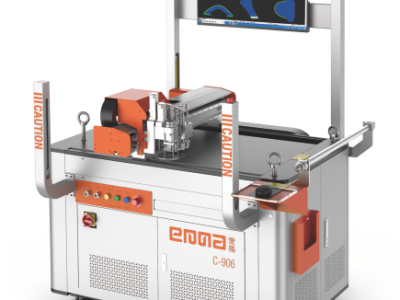
Ultrasonic cutting uses high-frequency vibration — typically between 20kHz and 40kHz — transmitted through a metal blade or horn. The vibration generates localized friction heat at the cut point, which simultaneously cuts and seals the fabric edge. There is no external heating element, no blade sharpening requirement, and no thermal overshoot risk.
For terry cloth specifically, ultrasonic cutting addresses the fraying problem at a structural level. The looped pile that makes terry fabric absorbent is also what makes it prone to unraveling at cut edges. A conventional blade separates fibers; an ultrasonic blade fuses them. The result is a sealed edge that feeds into hemming with consistent geometry and no loose pile to catch in the sewing head.
The operational advantages compound quickly. No blade sharpening means no sharpening downtime. No sharpening downtime means the line runs continuously without the 15 to 30 minute maintenance interruptions that traditional blade systems require. Across a three-shift operation, those recovered minutes accumulate into measurable throughput gains — often 8% to 12% additional cutting capacity per shift without any change to line speed.
Energy consumption in ultrasonic systems is also lower than heated knife alternatives. A traditional heated knife system runs its thermal element continuously to maintain cutting temperature. Ultrasonic systems activate energy only at the moment of contact. For mills operating 20+ hours per day, the kilowatt-hour difference across a year is not negligible.
Towel Automation Machines Provider Perspective: What Integration Actually Looks Like
When selecting between cutting technologies, the integration context matters as much as the cutting mechanism itself. A cutting machine does not operate in isolation — it sits between a slitting station and a hemming machine, and its output quality directly governs what the next station can produce.
As a dedicated Towel Automation machines provider, Texserco works with mills across Pakistan and internationally to configure complete cutting and hemming lines, not just individual machines. The Bando and Alpha (Powered by Bando) systems available through Texserco are designed for integrated line operation — auto-length measurement, PLC-controlled cutting, and direct feed into hemming stations running at up to 20 meters per minute with 8 stitches per inch. When a cutting machine and a hemming machine share PLC logic, length tolerances can be maintained within ±1mm across an entire production run, which is operationally impossible in a manually supervised system.
The knife sharpening equipment available through Texserco complements these cutting systems directly, ensuring that traditional blade-based cutting operations maintain consistent edge quality between sharpening cycles. This is not a generic accessory offering — it is a recognized dependency in production line performance that most machine suppliers do not address explicitly.
Comparing the Two Methods: Where Each Performs
Cut Edge Quality
Ultrasonic cutting produces a sealed edge on synthetic blends and cotton-synthetic terry without thermal discoloration. On 100% cotton terry, the edge seal is less pronounced because cotton fibers do not fuse the way synthetics do — though fraying is still significantly reduced compared to cold blade cutting. Traditional cutting on 100% cotton with sharp blades produces acceptable edges, but blade condition is the critical variable. A blade 30% into its wear cycle will fray cotton terry noticeably.
Production Speed Consistency
Traditional mechanical cutting can match or exceed ultrasonic cutting in raw speed when the blade is sharp. The gap appears over time: ultrasonic systems maintain consistent cut quality across an entire shift without intervention. Traditional systems degrade gradually, requiring operator adjustment and periodic blade changes that interrupt throughput. Over an 8-hour shift, ultrasonic systems typically deliver more consistent average output than blade-based alternatives.
Maintenance Profile
Ultrasonic systems require periodic replacement of the cutting horn, which is a wear component, but replacement intervals are significantly longer than blade sharpening cycles. Horn replacement is typically scheduled maintenance rather than reactive maintenance — a critical distinction for production planning. Traditional cutting systems require reactive sharpening (when quality drops) and scheduled sharpening (preventive cycles), plus periodic replacement of pressure components, blade carriages, and feed mechanisms.
Fabric Flexibility
Traditional cutting handles a wider range of fabric weights and constructions with fewer adjustments. Very heavy terry constructions — hotel bath sheets at 600–800 GSM — can be cut reliably with high-quality rotary or guillotine blades. Ultrasonic systems perform excellently in the 300–600 GSM range common to most export towel production, but very heavy constructions may require higher-power ultrasonic units.
Cost Profile
Capital cost for ultrasonic cutting systems is higher than comparable traditional blade systems. The operational economics shift the comparison over time: lower consumable costs (no blade replacement cycles), reduced maintenance labor, and higher consistent throughput typically bring ultrasonic system TCO below traditional cutting within 18 to 36 months for high-volume operations. Lower-volume operations or those with existing blade maintenance infrastructure may find the payback period extends to 4+ years.
PLC Integration and Quality Data: The Overlooked Advantage
Modern towel cutting automation — whether ultrasonic or traditional — is increasingly defined not just by the cutting mechanism but by the control and data layer surrounding it. PLC-controlled systems with touch screen interfaces can log cut count, speed, length variance, and error events continuously. This data is the foundation of quality traceability for export-grade towel production.
A buyer requiring AQL compliance documentation needs evidence that production parameters were controlled, not just that final product passed inspection. A cutting machine with PLC logging provides that evidence at the process level. A manually operated cutting system provides nothing except finished product inspection records — which is a fundamentally weaker quality claim.
For Pakistani towel mills supplying European or North American retail chains, process-level quality documentation is increasingly a buyer requirement, not a differentiator. Mills that cannot provide it are progressively excluded from preferred supplier programs, regardless of product quality.
Practical Decision Framework for Mill Operators
The choice between ultrasonic and traditional cutting automation is not purely technical — it depends on production context.
Ultrasonic cutting is the stronger choice when:
- Your product mix includes synthetic-blend terry towels where edge sealing is a finish requirement
- You operate two or three shifts with limited maintenance windows between shifts
- Your buyers require consistent edge quality documentation for AQL compliance
- Your line runs at 200–600 GSM product weight as the primary range
- You are building a new line or replacing an existing cutting station as part of a full automation upgrade
Traditional mechanical cutting with quality knife sharpening remains viable when:
- Your product mix is predominantly 100% cotton at heavy GSM weights where blade cutting is technically sufficient
- You have established knife sharpening infrastructure and skilled maintenance staff
- Your capital budget constrains ultrasonic system investment
- Your production volume is below the threshold where ultrasonic TCO advantages materialize within a planning horizon
In both cases, the cutting machine’s integration with downstream hemming equipment is the deciding operational factor. A technically superior cutting method that produces poor dimensional consistency because it is not synchronized with the hemming line provides less value than a simpler cutting system running in properly calibrated coordination with a hemming machine.
What Consistent Cut Quality Means for Your Hemming Line
The relationship between cut quality and hemming machine performance is worth examining specifically. Auto hemming machines — including the Bando and Alpha systems used in Texserco-equipped mills — are designed to receive fabric with consistent length dimensions and edge geometry. When cut length varies beyond the machine’s tolerance window, the hemming station requires manual adjustment, slows production to accommodate inconsistency, or produces off-spec hems that require rework.
A cutting system maintaining ±1mm length tolerance feeds the hemming machine within its designed operating parameters. A system maintaining ±5mm length tolerance forces the hemming machine to work outside its optimal range, which increases hem thread breakage, stitch irregularity, and machine head wear. The cost of that wear is deferred but real — earlier replacement of sewing heads, increased thread consumption, and higher rejection rates at final inspection.
This is why Texserco approaches towel automation as a line configuration question, not a single-machine selection. The cutting station, slitting station, and hemming station function as a system. Optimizing one station while underspecifying the others produces a bottleneck at the weakest link.
10 Frequently Asked Questions
What is the main difference between ultrasonic and traditional towel cutting in terms of output quality?
Ultrasonic cutting seals fabric edges during the cut using high-frequency vibration, which significantly reduces fraying on synthetic-blend terry. Traditional blade cutting separates fibers without sealing, making edge quality highly dependent on blade sharpness at the moment of cutting. For 100% cotton terry, sharp blade cutting produces acceptable edges; for synthetic blends, ultrasonic cutting produces more consistent sealed edges.
How often do blades need sharpening in a traditional towel cutting system?
In a high-volume mill running two or three shifts, cutting blades typically require sharpening every 48 to 72 hours of cutting operation. This varies with fabric weight, construction, and blade material. The sharpening cycle is a production dependency — lines either stop during sharpening or run with degraded blade performance, both of which carry production costs.
Does Texserco supply knife sharpening equipment for traditional cutting systems?
Yes. Texserco supplies dedicated knife sharpening equipment specifically suited to the blade geometries used in towel cutting machines. Proper sharpening equipment is not interchangeable with generic grinding tools — blade bevel angle, edge finish, and tip geometry must be maintained to the cutter’s specification to restore actual cutting performance rather than just edge appearance.
What GSM range is suitable for ultrasonic towel cutting?
Ultrasonic towel cutting systems perform most effectively in the 300–600 GSM range, which covers the majority of export-grade bath towels, hand towels, and face towels. Very heavy constructions at 700–900 GSM may require higher-power ultrasonic units. Traditional blade cutting handles heavy GSM more readily with less equipment modification.
How do Bando and Alpha cutting and hemming machines maintain length consistency?
Bando and Alpha (Powered by Bando) systems use PLC-controlled auto-length measurement to govern cut position. The PLC system measures fabric feed length continuously and triggers the cutting mechanism at precise intervals, maintaining length tolerance within ±1mm across a production run. This consistency is achieved through encoder-based feed measurement rather than timed cutting cycles, which would drift with fabric tension variation.
What is the typical production speed of automated towel cutting lines?
Automated towel cutting and hemming lines in the Bando and Alpha range operate at up to 20 meters per minute with consistent stitch quality of 8 stitches per inch. This is significantly faster than semi-automated or manually-fed cutting lines, where throughput is limited by human feeding speed and alignment time.
Can a traditional cutting machine be integrated with a PLC-controlled hemming system?
Yes, with appropriate interfacing. However, the integration is more straightforward when cutting and hemming systems are designed by the same manufacturer or are engineered for compatibility. Retrofitting PLC synchronization between a legacy cutting machine and a modern hemming system often requires custom sensor and control work. Texserco can assess integration feasibility during the consultation process.
What should a mill expect during machine installation and commissioning?
Installation of automated towel cutting and hemming equipment involves mechanical installation, electrical connection, PLC programming verification, and calibration runs with production fabric. Texserco provides on-site installation and commissioning support, including operator training on touch screen HMI operation, parameter setting, and basic troubleshooting. Initial calibration typically requires 1–2 production days to establish length settings for each product code in the mill’s range.
What is the total cost of ownership comparison between ultrasonic and traditional cutting systems over five years?
For high-volume operations, ultrasonic systems typically reach TCO parity with traditional blade systems within 18 to 36 months due to elimination of blade consumables, reduced maintenance labor, and higher consistent throughput. After that point, the ultrasonic system provides positive cost advantage. For lower-volume operations, the payback period extends. The calculation should include blade cost, sharpening labor, maintenance downtime, and quality rework costs — not just the capital cost differential.
How does Texserco support clients after machine purchase?
Texserco provides after-sales technical support including on-site troubleshooting, spare parts supply, PLC and HMI programming assistance, and maintenance consultation. With 22+ years of operation and 500+ machines installed across 15+ countries, Texserco maintains the technical depth to diagnose production problems at the system level — not just replace parts. Clients including Al Karam Towel Industries, Feroze1888, and United Towels Exporters have cited fast response time and accurate first-diagnosis as distinguishing factors in Texserco’s service quality.