
Material yield and edge clean-cut metrics dictate profitability in industrial leather manufacturing. Traditional die-cutting methods, while fast, suffer from tooling inflexibility and geometric distortion along complex curves. Manual cutting introducing human error is non-viable for high-throughput environments. Computer Numerical Control (CNC) systems have addressed scale, but cutting flexible, non-homogeneous substrates like genuine leather presents unique mechanical challenges. Leather varies in density, fiber orientation, and tensile strength across a single hide, causing shifting, tearing, or edge fraying under standard static blades. The industrial response to these structural variances lies in specialized automated cutting tables. To prevent structural deformation during high-speed processing, modern cutting systems must dynamically adapt their mechanical force based on the material’s resistance. When executing tight radii or micro-perforations, a static blade exerts lateral drag, stretching the leather fibers and distorting the final component’s dimensions.
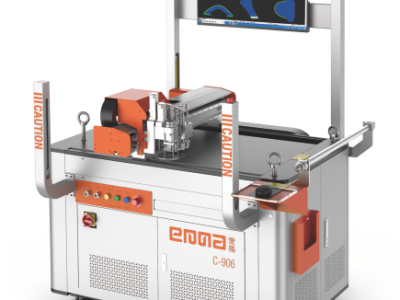
Eliminating this structural distortion requires a system that separates material penetration from forward travel. Engineered precisely for high-capacity industrial environments, the Emma CNC Leather Cutting Machine addresses these challenges through an advanced oscillating knife head configuration. This architecture replaces continuous lateral shearing force with high-frequency, vertical reciprocating micro-strokes. By delivering thousands of controlled vertical penetrations per minute, the system shears through dense leather collagen structures without dragging the material along the toolpath. This capability allows manufacturers to maintain tight nesting tolerances of under one millimeter, minimizing scrap and maximizing the utilization of premium hides.
The Kinematics of Oscillating and Rotary Tooling
The core processing power of the Emma CNC cutting head relies on dual tooling mechanisms: an electrically or pneumatically driven oscillating knife and a high-torque rotary blade. Understanding the mechanical division of labor between these two tools is vital for optimizing throughput across different material grades. The oscillating knife operates using an eccentric drive mechanism linked to a high-speed brushless servo motor. This motor converts rotary motion into linear vertical reciprocation. The knife moves rapidly up and down, with stroke amplitudes typically ranging from 1mm to 5mm depending on the material thickness. Because the blade spends a fraction of a millisecond in contact with the substrate during each stroke, lateral friction drops significantly. This rapid vertical action allows the CNC program to execute sharp 90-degree corners, intricate internal slots, and complex filleted geometries without lifting the tool head or tearing the leather fibers.
[Eccentric Drive Motor] ➔ [Vertical Reciprocating Stroke (1-5mm)] ➔ [Perpendicular Material Penetration]
For extended, continuous linear geometries or broad radial arcs, the system can deploy a motorized rotary blade. Rather than reciprocating, the rotary tool uses a circular blade that spins at high RPMs to slice cleanly through the material. This rolling contact eliminates the drag associated with static blades and cuts faster than oscillating tools on straight vectors. The Emma control system automatically switches between these tools within a single nested layout. It assigns the rotary blade to long perimeter cuts to maximize speed, and engages the oscillating knife for intricate internal paths, notches, and tight curves to preserve geometric accuracy.
Vacuum Bed Dynamics and Material Stabilization
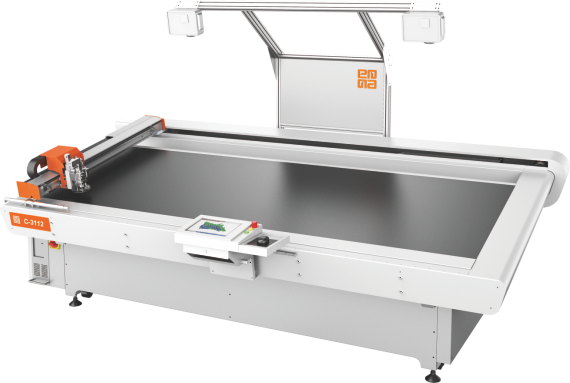
A precision cutting edge is ineffective if the leather substrate shifts or deforms during processing. Due to the natural contours and varying flatness of genuine hides, material stabilization requires a robust hold-down system. The Emma platform uses a multi-zone high-pressure vacuum extraction bed to address this. The cutting surface is divided into independently controlled vacuum zones managed by an automated matrix. When the nesting software positions a hide on the cutting table, the CNC controller activates only the vacuum cells directly beneath the material. This concentrates the atmospheric downforce precisely where the cutting action occurs, preventing pressure drops from exposed areas of the bed. A high-efficiency regenerative blower generates this vacuum pressure, pulling the leather flat against a sacrificial matrix felt or durable polyurethane conveyor belt.
This localized pressure counteracts the vertical lifting forces generated by the ascending stroke of the oscillating knife. By keeping the leather perfectly flat and motionless, the vacuum system ensures the blade enters the material at a true 90-degree angle across the entire toolpath. This accurate stabilization eliminates undercuts and overcuts, ensuring that pieces cut from the perimeter match those cut from the center of the bed.
Blade Metallurgy, Geometries, and Wear Mitigation
Industrial leather cutting subjects blades to intense friction, thermal stress, and abrasive wear from chemical tanning agents. Maintaining edge integrity requires advanced metallurgy and application-specific blade geometries. Emma utilizes solid tungsten carbide (WC-Co) blades, formulated with a sub-micron grain structure to optimize hardness and fracture toughness. These blades are often enhanced with specialized physical vapor deposition (PVD) coatings, such as Titanium Carbonitride (TiCN) or Diamond-Like Carbon (DLC). These coatings reduce the coefficient of friction at the cutting interface, lowering heat buildup and preventing melted tanning resins or synthetic topcoats from adhering to the blade flank.
Choosing the right blade geometry depends on the specific leather grade being processed:
- Flat Stock Oscillating Blades: Feature a steep, double-angle bevel designed for dense, heavy-ounce vegetable-tanned leathers. The primary angle provides structural support to the cutting edge, while the secondary bevel reduces penetration resistance.
- Pointed/Trailing-Edge Blades: Engineered with an aggressive tip angle for soft, pliable upholstery or garment leathers. The sharp point ensures clean initial penetration, while the slim profile allows the blade to turn within its own width for intricate detailing.
- Serrated-Edge Variations: Designed for fibrous, pull-up, or oil-tanned leathers, these blades feature micro-serrations along the cutting edge. They capture and shear loose fibers that might otherwise bend around a smooth blade profile.
Managing tool wear requires systematic calibration. As a carbide edge degrades, penetration resistance increases, which raises motor current draw and can lead to micro-fraying along the cut line. Implementing automated optical blade calibration checks allows the system to adjust for slight tool wear along the Z-axis, ensuring consistent cut depth and clean edges throughout extended production runs.
Software Integration, Nesting Optimization, and Real-Time Control
The physical cutting mechanics are directed by an integrated software ecosystem that translates CAD patterns into optimized machine code. This process relies on nesting algorithms designed to maximize yield from irregularly shaped natural hides. Before cutting begins, the system maps the hide’s perimeter using a high-resolution overhead digital camera or optical scanning bed. This vision system identifies the exterior boundaries and allows operators to mark surface defects like scars, brands, or insect bites. The nesting software then runs iterative algorithms to fit the required component geometries within the clear zones of the hide. By calculating spatial orientation across millions of combinations, the software routinely achieves material utilization rates exceeding 85%, significantly reducing waste compared to manual layout methods.
Once the layout is finalized, the CAM engine generates highly precise toolpaths. These toolpaths incorporate dynamic acceleration and deceleration curves. When approaching a sharp corner, the controller automatically reduces the X-Y feed rate while maintaining or increasing the knife’s oscillation frequency. This prevents the tool head from overshooting the vector and ensures clean, precise corners without burning or tearing the material.
Technical Troubleshooting and Maintenance Protocols
Maintaining operational efficiency and preventing unplanned downtime requires strict adherence to technical maintenance schedules. The high-frequency mechanical motion of the oscillating tool head demands regular inspection and precise calibration.
Mechanically Driven Oscillating Heads
The internal eccentric bearings and linear guide rails experience continuous vibrational stress. These components must be lubricated with high-viscosity synthetic grease every 40 operational hours to prevent thermal expansion and micro-play. Any mechanical play within the tool holder will manifest as dimensional drift on the cutting bed, especially during high-speed direction changes.
Pneumatic Driving Systems
For systems utilizing pneumatic oscillating heads, air supply quality is critical. The compressed air line must pass through a multi-stage filtration system consisting of a water separator, a coalescing filter to remove oil aerosols, and a pressure regulator. Moisture in the air line causes internal corrosion of the precision spool valves and cylinder walls, leading to erratic oscillation frequencies or sudden pressure loss. Supply pressure must be maintained at a stable 0.6 to 0.7 MPa, with daily drainage of the filtration traps.
Vacuum System Maintenance
A drop in holding pressure usually indicates a clogged filtration system rather than blower failure. Over time, leather dust, fiber fragments, and scraps accumulate in the vacuum plenum and main intake filter. This buildup restricts airflow and reduces holding force. Cleaning the primary intake filters weekly and reversing air pressure through the vacuum bed sections ensures the suction remains powerful enough to secure heavy hides during high-speed cutting operations.
Frequently Asked Questions
What is the maximum material thickness the Emma oscillating knife can process?
The system effectively cuts genuine leather and dense composite substrates up to 15mm thick. Processing thicker materials depends on selecting a blade with an appropriate stroke length and a high-power pneumatic tool head to ensure clean, vertical penetration throughout the material.
How does the system handle natural grain variances across a single hide?
The combination of a high-pressure multi-zone vacuum bed and high-frequency vertical blade oscillation minimizes the impact of grain variances. The vacuum holds the material perfectly flat, while the rapid vertical strokes shear through changing fiber densities without stretching or tearing the substrate.
What are the operational differences between electric and pneumatic oscillating heads?
Electric oscillating heads use an electric servo motor to deliver precise frequency control and constant torque, making them ideal for standard leathers and intricate geometries. Pneumatic heads utilize compressed air to generate higher impact forces, which is preferable for cutting thick, dense, or heavily oiled leathers.
How often do the tungsten carbide blades need to be replaced?
Blade lifespan varies based on leather density, backing material, and cutting speed. In a standard two-shift production environment processing mid-weight upholstery leather, a high-quality coated tungsten carbide blade typically maintains peak cutting efficiency for 16 to 24 hours of active cutting time before requiring replacement or sharpening.
Can the cutting machine process synthetic materials like Alcantara or heavy vinyl?
Yes. The tool head accommodates various blade geometries and speed settings tailored for synthetic textiles. For synthetics, operators can adjust the oscillation frequency and use specialized cooling attachments to prevent thermal fusion along the cut edges.
How does the overhead vision system identify surface defects on the leather?
The system utilizes a high-resolution digital camera paired with calibrated LED lighting to capture the hide’s surface. Operators can manually tag defects on the digital preview, or advanced AI-driven software modules can automatically detect variations in color and texture to route cuts away from flawed areas.
What maintenance is required for the sacrificial conveyor felt or cutting matrix?
The matrix felt should be regularly brushed or vacuumed to remove embedded debris. To ensure even wear across the bed, operators can use a built-in resurfacing cycle that lightly shaves the top layer of the felt, extending its usable life and maintaining a perfectly flat cutting surface.
Why does the machine slow down when cutting tight radial turns or sharp corners?
The CNC controller uses dynamic feed-rate optimization to maintain geometric accuracy. Slowing the linear travel speed during sharp turns prevents lateral forces from flexing the blade, ensuring the cut remains perfectly vertical and true to the CAD profile.
How does the system prevent the blade from cutting into the metal vacuum bed?
The machine uses an automated Z-axis initialization sensor to establish the exact location of the cutting matrix. The software calibrates the blade tip to penetrate the leather completely and enter the sacrificial felt by only a few tenths of a millimeter, protecting the aluminum vacuum table underneath.
What type of file formats does the nesting and control software support?
The integrated CAM software supports standard vector file formats used across the manufacturing industry, including DXF, PLT, AI, and HPGL. This compatibility allows seamless integration with existing CAD pattern design systems without requiring file conversion.