
Manufacturing heavy terry fabrics introduces a unique set of mechanical and logistical hurdles that standard garment processing simply cannot handle. The intrinsic weight, loop structure, and stretchability of the material mean that manual handling often leads to geometric distortion, inconsistent tension, and compromised product quality. When operators manually transport heavy rolls between cutting and hemming stations, the structural integrity of the fabric degrades. The core issue lies in the accumulation of minor inefficiencies. Relying on human intervention for edge alignment or batch counting creates immediate bottlenecks, particularly at the folding and stacking stages. Unplanned downtime caused by jammed sewing heads or misaligned slitting knives directly impacts output margins. The true cost of manual processing is not just in labor overhead, but in the catastrophic mechanical degradation and material waste generated by inconsistent human pacing mismatched with high-speed machine capabilities.
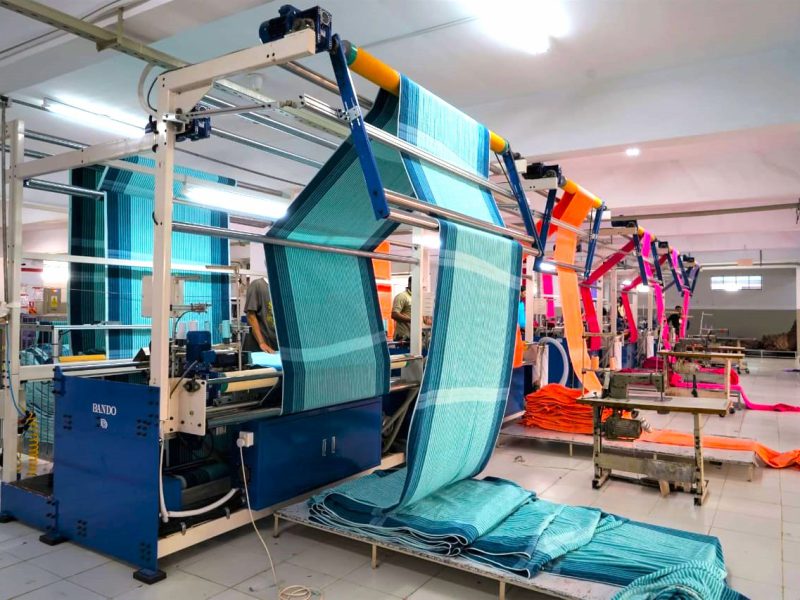
Transitioning toward mechanical synchrony requires specialized, programmable infrastructure designed specifically for high-GSM fabrics. Implementing robust Towel Automation bridges the vital gap between raw fabric rolls and ready-to-ship inventory. Programmable logic controllers combined with optical sensors take over the tedious tasks of edge alignment, precision cutting, and cross-hemming, ensuring that the fabric moves through the processing line with mathematical precision. Optical edge-guiding systems detect the slightest deviations in the fabric path, sending micro-corrections to servo motors in real-time. This eliminates the skewing that typically plagues heavy woven materials.
By stabilizing the web tension across the entire width of the machine, facilities can execute longitudinal cutting without fraying the terry loops or compromising the selvedge. Modern facilities require precise engineering to maintain continuous workflows. Utilizing dedicated textile machinery allows floor managers to minimize the physical touchpoints that often result in soiled or misaligned products. By integrating modular cutting, hemming, and folding units into a single continuous sequence, the production line transforms from a series of isolated, disjointed tasks into a unified, high-speed operation.
The Mechanics of Tension Control and Edge Alignment
Handling raw terry fabric requires a delicate balance of force. Excessive tension stretches the fabric, causing the final product to warp once relaxed. Insufficient tension results in bunching, which jams rotary blades and causes catastrophic thread breaks during the sewing phase. Automated systems utilize closed-loop tension controllers equipped with load cells. These sensors continuously measure the exact pull on the fabric web, feeding data back to the central drive system to adjust the speed of the feed rollers instantaneously.
Edge alignment operates on a similar principle of continuous feedback. Photoelectric sensors or ultrasonic edge detectors scan the borders of the moving web. If the fabric drifts even a millimeter off center, the pivoting guide rollers adjust the angle of approach, steering the material back to absolute zero. This level of microscopic management guarantees that longitudinal slitting occurs exactly between the pile-free weaving channels, eliminating waste and producing perfectly straight borders.
Mitigating the Cost of Unplanned Downtime
Machinery operates under immense physical stress, and the friction generated by processing thousands of meters of heavy textile takes a toll on moving parts. Traditional reactive maintenance results in sudden, catastrophic motor failures or broken drive chains that halt the entire factory floor. Advanced manufacturing systems prioritize predictive analytics over reactive repairs. Sensors monitor the vibration frequencies and thermal output of critical servo motors. When these metrics deviate from their baseline signatures, the human-machine interface alerts operators to specific degrading components before they fail. Lubrication schedules are automated and tracked digitally, ensuring that rotary blades and sewing hooks receive precise amounts of oil based on operating hours rather than arbitrary calendar dates. This proactive strategy drastically reduces mechanical degradation and keeps the line running continuously.
Quantifiable Output Metrics
Transitioning away from manual processing yields immediate, measurable improvements across the production floor. Integrating smart machinery provides clear operational advantages that directly impact profitability.
- Reduction in Material Waste: Precision optical edge-guiding limits slitting errors, reducing fabric waste margins from typical industry averages to near-zero tolerances.
- Increased Hemming Throughput: Synchronized cross-hemming units operate continuously without stopping for manual realignment, yielding significantly higher units per hour.
- Labor Reallocation: Consolidating cutting, sewing, and folding into a continuous line allows management to shift manual operators to quality assurance and logistics.
- Energy Efficiency: Servo-driven motors consume power strictly on demand, reducing baseline electrical draw compared to traditional continuously running clutch motors.
- Predictable Output Yields: Digital batch tracking and automated stacking provide exact inventory counts, eliminating manual counting errors and delayed shipping schedules.
Longitudinal Cutting and Cross-Hemming Precision
The physical act of transforming a massive fabric roll into individual units requires absolute synchronization. Longitudinal slitting utilizes motorized circular knives that rotate in counter-direction to the fabric feed, creating a clean, sheer cut through the pile-free channels. Electronic encoders track the exact speed of the fabric, ensuring the knives accelerate or decelerate in perfect harmony with the web. Once cut into lanes, the material enters the cross-hemming phase. This is arguably the most complex mechanical sequence in the facility. The fabric must be cut horizontally to the exact specified length, and the raw edges must be immediately folded and stitched to prevent unravelling.
Automated cross-hemmers utilize mechanical folding fingers and compressed air jets to double-fold the edges before feeding them into high-speed sewing heads. Thread breakage is a common complication in high-speed stitching, often caused by friction heat melting the synthetic thread blends. Automated systems incorporate needle cooling systems and intelligent thread tensioners that release pressure during thick cross-seams. Optical thread-break detectors instantly halt the specific sewing head the moment a break occurs, preventing unstitched items from moving downstream and accumulating in the finished pile.
Programmable Logic Controllers and Software Integration
The physical hardware of a factory line is only as capable as the software commanding it. Programmable Logic Controllers serve as the central nervous system of the entire operation. Instead of manual dials and mechanical cams, floor managers use touch-screen interfaces to input exact product specifications. If the production schedule shifts from a standard bath size to an oversized beach dimension, the operator selects the new recipe via the interface. The PLCs instantly communicate the new length parameters to the cross-cutting blades, adjust the folding plate widths, and modify the stacking conveyor speeds. This eliminates the hours of mechanical tweaking previously required during changeovers. Software integration also allows for extensive data logging. Floor managers can review historical production speeds, analyze the frequency of machine stoppages, and pinpoint specific operational bottlenecks.
Advanced Folding and Stacking Mechanics
The final stage of production often dictates the visual presentation of the product. Heavy textiles resist folding, trapping air between the layers and creating bulky, uneven stacks that complicate packaging. Manual folding is notoriously inconsistent, leading to lopsided batches that fail quality control inspections. Automated multi-lane folders resolve this through a combination of mechanical arms and targeted pneumatics. As the item moves across the conveying belt, optical sensors trigger precision air blasts that force the fabric downward between heavy folding rollers. This method expels trapped air and creates crisp, tight creases.
Once folded, the items are transferred to automated stacking units. These stackers index downwards incrementally as each new item is added, maintaining a consistent drop height. This prevents the pile from toppling or skewing. Once the programmed batch count is reached, a conveyor automatically ejects the completed stack to the bagging station, resetting the platform for the next cycle without requiring the machine to pause.
Managing Terry Cloth Specific Challenges
Terry woven materials generate massive amounts of airborne lint and dust during the cutting and sewing processes. This shedding is not merely a cleanliness issue; it is a serious mechanical hazard. Airborne lint aggressively targets open bearings, clogs pneumatic valves, and coats optical sensors, causing the machinery to misread inputs and malfunction. High-end manufacturing lines incorporate localized vacuum extraction points directly at the slitting knives and sewing heads. These systems capture lint at the point of generation before it can migrate into sensitive mechanical bays. Enclosed electronic cabinets with positive pressure ventilation prevent dust from settling on circuit boards and PLCs. Keeping the internal mechanics isolated from the harsh realities of the factory floor is critical for maintaining long-term precision and operational longevity.
Overcoming Implementation Hurdles
Transitioning a facility to a centralized, software-driven architecture requires careful planning regarding floor layout and power distribution. The physical footprint of a continuous line demands adequate space for material staging and finished goods retrieval. Furthermore, the electrical infrastructure must support the high-amperage draw of multiple servo drives initiating simultaneously.
Facilities must also account for compressed air requirements. The pneumatic cylinders responsible for folding, stacking, and localized lint extraction rely on consistent air pressure. Drops in the facility’s pneumatic lines will cause sluggish mechanical responses, resulting in misfolded products or jammed cutting blades. Installing dedicated rotary screw compressors with high-capacity receiver tanks ensures that the machinery never starves for air during peak operational cycles.
Future-Proofing Factory Operations
Investing in scalable architecture allows manufacturing floors to adapt to shifting market demands without requiring total equipment overhauls. Modern lines are built modularly. If a facility needs to add an automated labeling station or integrate directly into an automated bagging machine, the physical space and software protocols are already designed to accept these additions seamlessly. Continuous firmware updates enhance sensor accuracy and refine motor synchronization long after the hardware is installed. By relying on data-driven metrics and robust mechanical engineering, facilities strip away the unpredictable variables of manual production. The focus shifts entirely to maximizing yield, preserving material integrity, consistent output.
FAQ’s
What causes geometric skewing during the transport of heavy textiles?
Geometric skewing occurs when uneven tension is applied across the width of the fabric web. If one side of the feed roller pulls slightly faster than the other, the heavy fabric warps, causing diagonal misalignment that ruins subsequent cutting and hemming processes.
How do optical sensors improve edge alignment accuracy?
Optical sensors continuously scan the extreme edges of the moving fabric. If they detect lateral drift, they instantly signal pivoting guide rollers to adjust their angle, steering the fabric back to the center line with millimeter precision before it reaches the slitting knives.
Why is pneumatic folding preferred over manual folding for heavy GSM fabrics?
Heavy fabrics trap air between layers when folded manually, creating bulky, unstable stacks. Pneumatic folding uses high-pressure air blasts combined with heavy mechanical rollers to force the air out, creating tight, crisp creases that stack uniformly.
What role do Programmable Logic Controllers play during product changeovers?
PLCs store specific product dimensions as digital recipes. When switching sizes, operators select the new recipe, and the PLC automatically adjusts cutting lengths, folding widths, and conveyor speeds electronically, eliminating hours of manual mechanical adjustments.
How does automated tension control prevent fabric distortion?
Closed-loop tension controllers use load cells to measure the exact pulling force on the fabric. If the tension exceeds programmed limits, the system instantly slows the feed rollers, preventing the material from stretching and ensuring accurate cut lengths.
What mechanisms prevent thread breakage during high-speed cross-hemming?
Advanced cross-hemmers utilize active needle cooling systems to reduce friction heat, intelligent tensioners that release pressure over thick seams, and optical detectors that instantly halt the machine if a thread snap occurs, preventing unstitched products.
How does localized vacuum extraction protect automated machinery?
Cutting and sewing terry cloth generates dense, abrasive lint that clogs pneumatic valves and blinds optical sensors. Localized vacuum systems pull this lint directly from the cutting blades and sewing hooks, preventing it from migrating into critical mechanical bays.
What is the advantage of using servo motors over traditional clutch motors?
Servo motors operate with absolute positional accuracy and consume electricity only when actively moving. They accelerate and decelerate instantly based on encoder feedback, unlike continuously running clutch motors which drain energy and lack precise speed control.
How do automated stackers handle varying pile heights without toppling?
Automated stackers utilize an indexing platform that lowers incrementally as each new folded item drops onto the pile. This maintains a consistent drop distance, ensuring the stack remains perfectly vertical and stable until the required batch count is achieved.
What data metrics indicate successful integration of a continuous production line?
Key indicators include a drastic reduction in manual handling touchpoints, stabilized energy consumption via servo utilization, near-zero fabric waste from precise slitting, and exact inventory batch counts verified by digital output logs.
Conclusion
Capitalizing on a continuous production line requires more than simply replacing manual workstations with motorized counterparts. It demands a fundamental shift in how floor managers view the lifecycle of heavy textiles moving through the facility. When every millimeter of longitudinal slitting and every stitch of cross-hemming operates under closed-loop sensory feedback, output variance drops to absolute minimums. The unpredictable nature of processing stretchable, loop-heavy materials is entirely neutralized by precision engineering.
Facilities that eliminate the stop-and-go friction of manual batch handling routinely see their capital equipment return on investment accelerate. By stabilizing web tension, executing flawless edge alignment, and enforcing strict predictive maintenance schedules, manufacturers protect their margins against the silent costs of material degradation and mechanical wear. Output becomes a reliable mathematical equation rather than a daily operational struggle.
Ultimately, true operational stability comes from total system synchronization. When the physical textile machinery seamlessly communicates with central programmable logic controllers, the factory floor transforms. It ceases to be a vulnerable collection of isolated cutting, sewing, and folding stations. Instead, it becomes a unified, highly calibrated engine engineered for relentless, predictable, and highly profitable output.