
Manufacturers running older textile finishing lines face a harsh operational reality on the factory floor. Mechanical degradation and manual handling create compounding inefficiencies that directly erode profit margins. Unplanned downtime is not merely an inconvenience; it represents thousands of lost production yards, delayed shipping schedules, and escalating labor costs when technicians are forced to stand idle. When machine operators have to manually intervene to adjust fabric tension, untangle thread jams, or realign mechanical cutting blades, overall factory output drops drastically. These complications multiply rapidly during high-volume production runs. Inconsistent manual feeding inevitably leads to irregular slitting, mismatched cross-cutting, and dropped stitches during the final hemming process.
Every rejected fabric batch pushes material waste upward while consuming additional electrical energy and labor for rework. Facilities relying on outdated, purely mechanical sewing heads struggle to maintain consistent stitch density across different fabric weights, directly compromising the final retail quality of the product. To eliminate these costly production gaps, facility directors are upgrading their infrastructure with intelligent, continuous-run systems. Integrating advanced Towel Automation machines replaces reactive mechanical adjustments with precise Programmable Logic Controllers. This upgrade synchronizes the entire workflow, allowing facilities to maintain continuous output speeds while virtually eliminating the mechanical faults that plague older textile equipment.
Engineering Precision in High-Speed Hemming Systems
Hemming remains one of the most mechanically demanding stages in textile finishing. Traditional setups frequently suffer from thread breakage and uneven tension due to abrupt motor starts and stops, requiring constant operator supervision and manual recalibration. Upgrading to automated length hemming systems introduces a level of mechanical stability previously unavailable. Utilizing heavy-duty Japanese sewing heads combined with advanced inverter technology, these systems manage fabric tension dynamically as the material moves through the needle path.
The technical advantage lies in the smooth modulation of electrical current. Inverter controls allow the sewing motors to accelerate and decelerate smoothly, entirely preventing the aggressive jerks that snap threads on legacy machines. Operators interact with intuitive touch screen panels to input specific parameters for stitch density and run length. Once programmed, the system executes these commands flawlessly across millions of continuous cycles. With operational speeds reaching up to twenty meters per minute and delivering exactly eight stitches per inch, the throughput outpaces manual hybrid setups exponentially.
This continuous, sensor-guided operation ensures that stitch quality remains identical from the first yard of the fabric roll to the last. By removing the human variable from the tensioning and feeding process, textile plants drastically reduce their defect rates. The equipment handles demanding manufacturing environments with ease, ensuring that hemming becomes a highly predictable, high-speed operation rather than a persistent production bottleneck.
Sensor-Driven Slitting and Material Waste Reduction
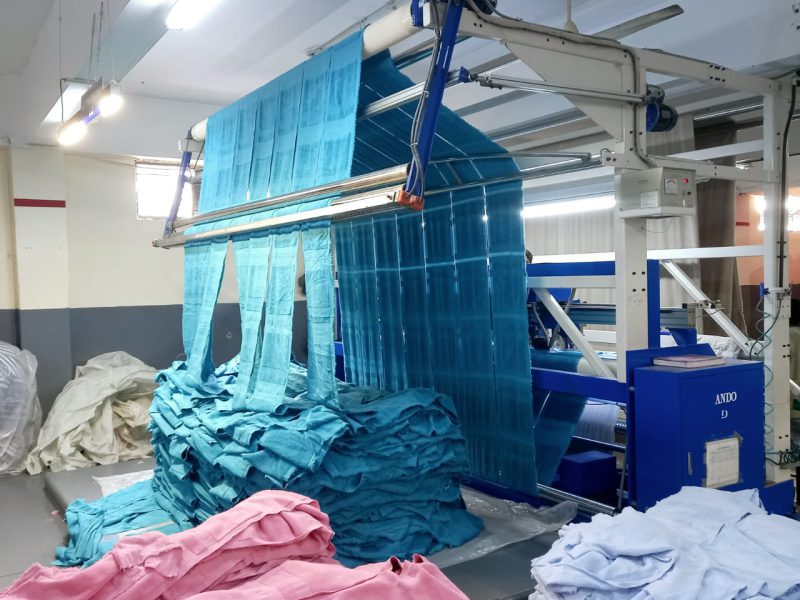
Fabric slitting requires absolute precision to prevent edge fraying and irregular panel widths. Manual or semi-automated slitting lines often drift off-center due to the heavy weight and varying stretch of terry cloth. This drift leads to inconsistent dimensions and excessive fabric waste. Modern automated length slitting equipment solves this physics problem by utilizing high-fidelity sensor-driven alignment tools that keep the heavy fabric perfectly centered as it is pulled through the cutting modules.
These automated systems measure lengths dynamically using digital encoders. As the heavy fabric roll unwinds, the logic board calculates the exact cut points required to maximize material usage and minimize scrap. The heavy-duty blades operate with extreme sharpness and structural stability, creating clean, perfectly sealed edges that are immediately ready for the final hemming phase. This level of cutting accuracy is mechanically impossible to sustain over twelve-hour shifts using manual cutting methods.
The quantifiable benefit for plant managers is direct, measurable material savings. By preventing irregular cuts and skewed edges, textile plants can save significant percentages of raw material per production cycle. Automated slitting guarantees uniform widths across massive production runs, ensuring that every finished item meets strict quality control standards before it ever reaches the final packing department.
Synchronizing the Cross-Cutting Workflow
Cross-cutting is the critical junction where continuous fabric finally takes its individual shape. Outdated machinery often struggles with the start-and-stop momentum required for this stage, leading to severe mechanical wear on drive belts, brake clutches, and gearboxes. Automated cross-cutting infrastructure mitigates this wear by utilizing continuous-feed mechanisms paired with rapid-action, electronically timed cutting modules.
The logic controllers within these machines anticipate the cut timing down to the millisecond. This exact digital timing ensures clean, accurate cross-cuts at high speeds without dragging or snagging the heavy fabric material. Minimal fabric waste is achieved because the cutting tolerances are programmed directly into the software, completely removing manual tape measuring and physical guesswork from the factory floor.
Combining cutting and hemming into a single, streamlined operation fundamentally upgrades the factory layout. Instead of utilizing forklifts or manual carts to move heavy fabric rolls between discrete workstations, the material flows continuously from slitting directly into cross-cutting and final hemming. This consolidated workflow slashes material handling time and vastly lowers the risk of the fabric becoming soiled or physically damaged during internal transport.
Mitigating Unplanned Downtime via HMI Diagnostics
The true operational power of modern textile equipment is hidden within its software architecture. Legacy machines fail silently, leaving maintenance crews guessing which specific belt, bearing, or motor caused the stoppage. Today, Human-Machine Interface panels combined with sophisticated Programmable Logic Controllers offer real-time, highly granular diagnostic data directly to the floor operators.
When a mechanical anomaly or tension error occurs, the interface pinpoints the exact location and nature of the fault on a digital layout of the machine. This visual diagnostic capability reduces troubleshooting time from several hours to mere minutes. Maintenance teams can address the specific component issue immediately, preventing minor mechanical friction from escalating into a catastrophic, line-stopping machine failure.
Furthermore, these interfaces allow for rapid production changeovers. Switching production from a heavy commercial bath sheet to a lighter residential hand towel requires entirely different tension, speed, and cutting parameters. Operators can load pre-programmed digital settings instantly via the touch screen, cutting changeover downtime to near zero. This mechanical flexibility allows facilities to accept diverse client orders without sacrificing overall production efficiency.
Conclusion
Relying on manual handling and legacy mechanical systems is no longer a viable strategy for textile facilities aiming to scale. The hidden costs of thread breaks, uneven slitting, and unplanned maintenance bottlenecks drain resources that should be allocated directly toward facility growth. Upgrading to advanced, sensor-driven finishing lines permanently resolves these structural inefficiencies at the source. By stabilizing thread tension, minimizing fabric scrap, and executing precise cuts at twenty meters per minute, automated equipment directly protects the profit margin of every production run.
Facility directors gain absolute control over their operational metrics, replacing daily mechanical guesswork with mathematical certainty. When production timelines become entirely predictable, manufacturers can confidently scale their output, secure larger retail contracts, and maintain peak quality standards without proportional increases in labor overhead. The transition to intelligent infrastructure is a fundamental operational requirement for maintaining competitive dominance in modern high-volume textile manufacturing.