

In high volume manufacturing sectors such as spinning mills, fabric weaving plants, and towel finishing factories, warehouses often receive large production batches containing hundreds of pallets with identical product codes. When managing uniform goods that move in bulk shipments, standard selective pallet racking wastes more than sixty percent of warehouse floor area on forklift maneuvering corridors. A heavy duty Drive In Pallet Racking System solves this spatial challenge by condensing pallet locations into continuous deep storage bays where forklifts enter the rack structure directly.
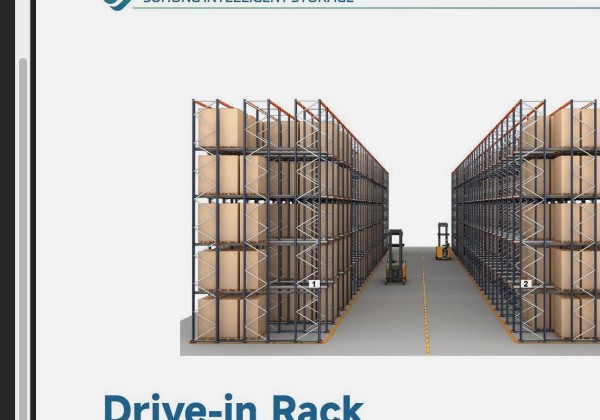
Structural Architecture and Cantilever Support Rails
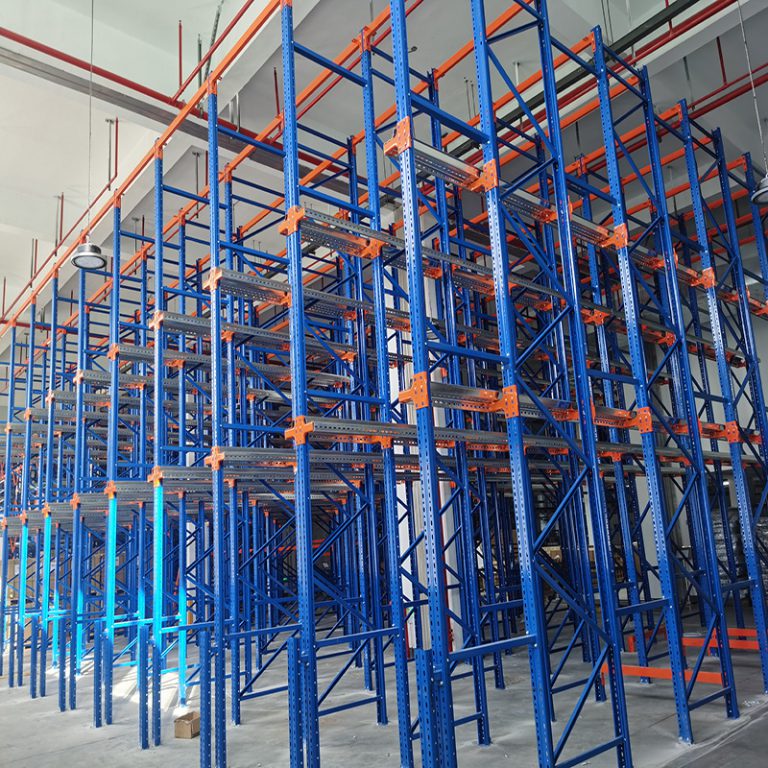
Unlike standard selective racks that support pallets on horizontal cross beams spanning between vertical frames, the Suhong Drive In Pallet Racking System eliminates conventional cross beams within the storage channels. Instead, pallets rest on continuous structural steel guide rails cantilevered from both sides of the vertical upright columns. This channel design allows counterbalanced forklifts and reach trucks to drive directly into the interior of the storage bay to deposit or retrieve pallets.
The vertical upright frames are fabricated from high yield Q235B cold formed structural steel with specialized omega cross sections engineered for superior torsional stiffness. Heavy duty top tie beams and overhead horizontal bracing link adjacent rack rows across the ceiling level, creating a unified rigid structural box that withstands dynamic forklift entry forces and heavy static pallet loads up to twelve thousand kilograms per bay.
Last In First Out Inventory Flow Mechanics
Drive in racking operates primarily on the Last In First Out principle, where the last pallet placed into a specific channel must be the first pallet retrieved. The forklift driver begins loading at the rearmost floor position of the channel, stacking subsequent pallets upward on higher rail levels before moving forward toward the aisle. When unloading, the driver extracts pallets from the front aisle face first, working inward toward the back wall.
This flow pattern is exceptionally well suited for textile manufacturing environments where production runs generate dozens of pallets of identical cotton yarn counts, raw greige fabric rolls, or standardized export terry towels. Because entire channels contain identical stock, retrieving the front pallet provides immediate access to the required inventory without needing to shuffle different product codes.
Floor Guide Rails and Forklift Protection Engineering
Because forklift trucks navigate inside narrow steel channels with only a few inches of clearance on either side of the chassis, structural protection is paramount. Suhong Drive In systems feature heavy duty hot rolled steel floor guide rails anchored firmly to the concrete slab along the entire length of every driving lane. These continuous steel angle rails physically guide forklift wheels, keeping the vehicle perfectly centered throughout entry and reverse travel.
At the channel entrance, heavy duty bell shaped steel entry guides flare outward, guiding forklift tires smoothly into the channel and preventing accidental tire impact against vertical rack uprights. Massive wrap around column post protectors absorb accidental bumper taps, preventing structural frame deformation and ensuring safe daily operation across busy warehouse shifts.
To examine detailed bay load capacities, rail heights, and narrow aisle forklift clearance specifications, visit the official Drive In Pallet Racking System product catalog page for engineering guidance and facility planning.
Essential Structural Inspection and Maintenance Protocols
Maintaining safety across high density drive in rack installations requires regular verification by qualified warehouse engineering staff:
- Daily aisle entry bell and floor guide inspection: Check floor mounted guide rails and entry bell guides for physical displacement, loose floor anchor bolts, or concrete cracking.
- Weekly pallet rail bracket torque audits: Inspect high tensile bolts connecting cantilever support brackets to upright columns, verifying torque retention under repeated pallet loading.
- Monthly column plumb and alignment verification: Use optical transit levels or precision laser instruments to verify upright plumbness along the entire length of interior driving lanes.
- Quarterly overhead bracing and top tie audits: Inspect horizontal and diagonal top tie beams spanning the roof of the rack structure, checking for loose fasteners or harmonic vibration loosening.
- Biannual pallet stop pin and rail deflection checks: Verify that rear pallet backstops remain securely fastened at the end of every rail channel, preventing pallets from pushing into wall clearances.
Pallet Quality and Dimensional Standardization
Successful operation of drive in racking depends heavily on the physical quality and dimensional consistency of warehouse pallets. Because pallets rest on side support rails rather than solid shelf decking, pallets must possess sound bottom runners and top deck boards without broken wood or protruding nails. Using standardized four way wooden pallets or heavy duty molded plastic skids guarantees stable, safe rail seating throughout deep storage channels.
Warehouse managers should enforce inbound pallet quality sorting. Any pallet exhibiting split stringers, loose bottom boards, or excessive moisture deflection must be rejected or transferred to a slave pallet before entering high elevation drive in channels. This strict pallet discipline prevents dangerous load slips and ensures trouble free forklift operations.
Comparative Density Advantages Over Selective Racking
When evaluated strictly on storage capacity per square foot of warehouse real estate, drive in racking outperforms standard selective racking by a wide margin. In a typical ten thousand square foot warehouse, standard selective racking accommodates approximately one thousand pallet positions due to the large number of wide forklift corridors required. Converting that same floor space to drive in racking increases storage capacity to over two thousand pallet positions.
For textile manufacturers operating in expensive urban industrial zones where warehouse leasing rates are high, this doubling of storage capacity eliminates the need to lease secondary facilities. All raw materials, work in progress yarn, and finished carton goods remain safely housed under one roof, slashing external trucking costs and streamlining factory logistics.
Top Tie Structural Bracing and Building Column Integration
Because drive in pallet racking eliminates conventional internal cross beams, structural rigidity depends entirely on top tie beams and vertical column anchors. Heavy duty structural steel portal beams span the top of each driving aisle, connecting adjacent upright frames into a continuous rigid space frame. In high ceiling facilities reaching elevations of ten to twelve meters, diagonal cross bracing across the roof of the rack creates high resistance against lateral sway forces caused by moving forklifts.
Engineering teams coordinate rack row spacing carefully with existing building structural columns. Positioning facility columns inside back to back rack flues preserves continuous open access lanes, preventing awkward vehicle maneuvers and maximizing usable floor area. Heavy duty column baseplates anchored with dual high tensile expansion anchors transfer dynamic vehicle braking forces safely into the thick reinforced concrete foundation slab.
Forklift Speed Governance and Operator Training Standards
Safe operation of drive in racking systems requires disciplined operator techniques and strictly enforced speed guidelines. Warehouse managers must govern forklift speeds to no more than five kilometers per hour when entering or exiting drive in channels. Driving with elevated mast loads inside narrow steel corridors requires steady acceleration, smooth steering, and absolute focus.
Comprehensive operator training curricula should instruct drivers on mast verticality verification before entering the lane. Forklift masts must remain strictly perpendicular to the floor without forward or backward tilt. Entering a channel with a tilted mast risks catching pallet corners on cantilever support brackets, potentially causing pallet tipping or rail damage. Certified training programs transform forklift drivers into skilled material handling professionals who operate with confidence and care.
Economic Payback and Capital Return Analysis
Drive in pallet racking represents one of the most cost effective high density storage investments available because it achieves dramatic space gains without relying on costly robotic machinery or complex electrical software. The system relies on proven structural steel engineering, standard forklift equipment, and straightforward operational disciplines.
The capital payback period for drive in racking installations typically ranges between twelve and eighteen months. Savings derive primarily from avoided offsite warehouse lease payments, reduced forklift travel distances, and reduced building heating and cooling expenses per stored pallet. For expanding mills seeking maximum storage volume on a sensible capital budget, drive in racking remains an outstanding industrial choice.