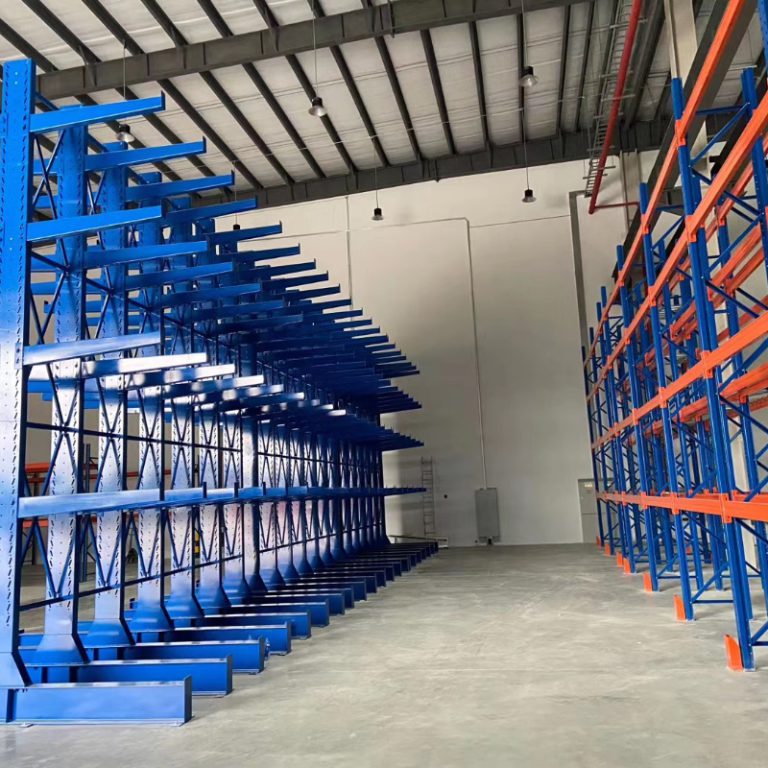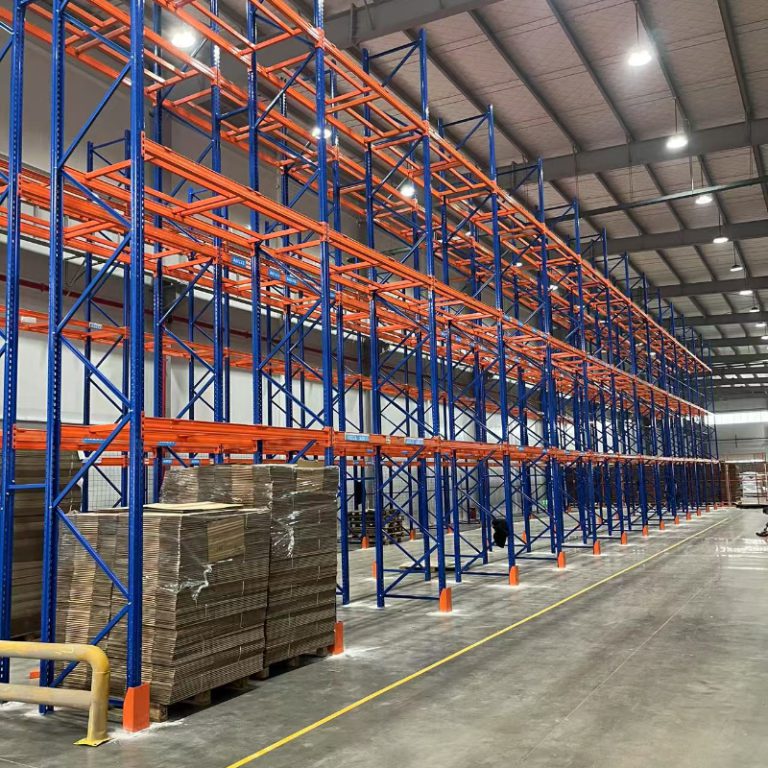


Textile mills, dying facilities, and industrial fabric converters handle vast quantities of long, heavy, and awkward materials daily. Woven cotton rolls, knitted fabric rolls, wide industrial carpet rolls, and metal conduit stock cannot be stacked efficiently on standard square pallets. When factories attempt floor stacking, bottom fabric rolls suffer severe crushing, warp distortion, and outer layer soilage, while accessing a roll stored beneath dozens of others requires tedious, dangerous forklift maneuvers. Installing a heavy duty Cantilever Racking System provides the open front architecture and structural strength required to store long materials safely and accessibly.
Structural Engineering and Open Front Architecture
The defining structural advantage of the Suhong Cantilever Racking System is the complete absence of front vertical column posts. Instead, the system consists of heavy duty vertical columns, robust horizontal base channels anchored firmly to concrete slabs, and horizontal load carrying arms extending outward. This open front design creates an uninterrupted linear shelf plane, enabling warehouse operators to store materials of any arbitrary length without being constrained by fixed frame uprights.
Fabricated from premium Q235B cold rolled structural steel, the upright columns feature high precision punching at fifty millimeter or seventy five millimeter vertical intervals. This close hole spacing allows warehouse staff to adjust arm heights easily to match shifting fabric roll diameters. Whether a mill stores slender forty millimeter gray yarn rolls or massive five hundred millimeter finished velvet rolls, arm elevations can be adjusted rapidly to eliminate unused vertical space.
Load Capacities and Deflection Dynamics
Structural reliability in heavy textile storage requires careful calculation of static and dynamic load vectors. Individual cantilever arms are engineered with load capacities ranging from five hundred kilograms up to eighteen hundred kilograms per arm, depending on arm length and steel thickness. Columns can reach elevations between three meters and seven point five meters, allowing mills to exploit the full cubic height of modern warehouse buildings.
Every cantilever arm features a calibrated slight upward incline of two to three degrees toward the outer tip. When heavy fabric rolls rest on the arm, structural steel deflection absorbs the weight smoothly without allowing the arm to drop below horizontal level. Removable steel end stop pins prevent round textile rolls from rolling off under seismic vibration or accidental forklift bumping, ensuring full operator safety across busy aisles.
Single Sided and Double Sided Warehouse Layouts
Cantilever racking adapts effortlessly to facility geometry through single sided and double sided column configurations. Single sided cantilever racks sit flush against structural facility perimeter walls, transforming idle peripheral space into high capacity roll storage. Double sided cantilever racks stand along central warehouse aisles, featuring load bearing arms extending symmetrically from both front and rear column faces.
Symmetrical loading on double sided racks balances overturning moments perfectly, maximizing overall structural stability while accommodating two parallel access aisles. When paired with side loader forklifts or narrow aisle reach trucks with specialized roll spreader prongs, cantilever aisles can be planned with generous clearances for rapid material retrieval without compromising storage density.
For complete engineering load tables, arm length options, and customized mill design schematics, consult the Cantilever Racking System product catalog page for expert advice and layout quotes.
Preventing Fabric Distortion and Product Degradation
Textile fabrics are delicate organic and synthetic polymers that suffer irreversible creasing and fiber compaction when stored incorrectly. When heavy fabric rolls are stacked pyramid style on concrete floors, the bottom rolls bear thousands of kilograms of dead weight. This crushing flattens the tubular cardboard cores, wrinkles inner fabric layers, and alters fabric dimensional stability before cutting.
Cantilever racking isolates each roll or layer onto independent structural arms. Air circulates freely around every roll, preventing heat buildup, moisture condensation, and mildew formation in humid textile environments. Rollers lift cleanly off arms using boom pole forklift attachments without dragging against adjacent goods, preserving pristine outer wrap integrity and reducing fabric scrap rates to virtually zero.
Optimizing Warehouse Inventory Retrieval Speeds
In addition to fabric protection, cantilever storage transforms warehouse inventory speed. In traditional floor stacked warehouses, finding a specific dye lot roll stored three rows deep requires moving dozens of overlying rolls, wasting thirty to forty minutes of forklift operator time. On cantilever racks, every single roll position remains visible and directly accessible from the aisle.
Barcode labels affixed to roll ends remain clearly visible to operators walking or driving down the aisle. Forklift drivers locate the requested fabric lot immediately, position the boom prongs, and extract the roll in less than ninety seconds. This rapid accessibility speeds up fabric delivery to spreading and cutting tables, keeping automated cutting machines running without material starvation.
Safety Inspection Schedules and Preventive Structural Upkeep
Maintaining structural safety across heavy industrial cantilever racking requires routine verification by qualified warehouse maintenance personnel:
- Daily floor clearance and obstacle checks: Ensure that main forklift operating aisles remain clear of wood splinters, loose strapping, and abandoned pallets that could deflect forklift steering.
- Weekly arm retention pin audits: Inspect arm connection pins and locking wedges on every column to verify that pins remain fully seated and undamaged.
- Monthly column plumb and verticality verification: Use optical leveling or precision spirit levels to confirm upright columns remain plumb within standard engineering tolerances.
- Quarterly floor anchor bolt torque testing: Check heavy anchor bolts securing column base channels to concrete foundations with a calibrated torque wrench, retightening any loosened nuts.
- Biannual arm deflection and weld audits: Visually examine welded seams between arms and column mounting brackets for stress cracking, paint flaking, or permanent deformation.
Forklift Guide Rails and Narrow Aisle Navigation
In high density fabric roll warehouses, reducing aisle width between adjacent rack rows allows facilities to add twenty to thirty percent more storage columns within the same building envelope. However, narrow aisles increase the risk of accidental forklift mast contact against cantilever columns. Installing continuous structural steel guide rails along floor boundaries provides a physical steering barrier that keeps side loaders and reach trucks perfectly centered throughout their travel path.
Drivers enter the guided aisle, engage the guide rollers mounted on the forklift chassis, and focus entirely on elevation and roll retrieval without needing to steer manually. This mechanical guidance speeds up travel velocities safely and virtually eliminates column impact risks, protecting capital assets and maintaining warehouse order during peak dispatch shifts.
Customized Arm Saddle Accessories for Delicate Fabrics
Specialty mills handling premium silk, micro denier polyester, or high pile knitted plush fabrics require additional contact protection beyond bare painted steel arms. The Suhong Cantilever Racking System accommodates snap on high density polyethylene arm covers and curved rubber saddles that cradle cylindrical rolls perfectly. These smooth non marking protective sleeves prevent pressure line creases and eliminate surface friction scuffs during roll placement and retrieval.
For operations storing variable diameter rolls on shared arms, adjustable steel spacer dividers prevent adjacent rolls from rolling into one another during seismic vibrations or handling turbulence. These practical accessories protect valuable textile stock, ensuring that finished goods reach cut and sew lines in pristine condition.
Before commissioning, professional load deflection testing confirms that each cantilever arm supports its rated weight without exceeding allowable deflection thresholds. Engineers apply test weights at center load points and outer tip locations, measuring deflection with dial indicators. Certified load rating plaques affixed to every column face give forklift operators clear visual confirmation of safe operating limits, establishing a culture of safety across industrial warehousing operations.