
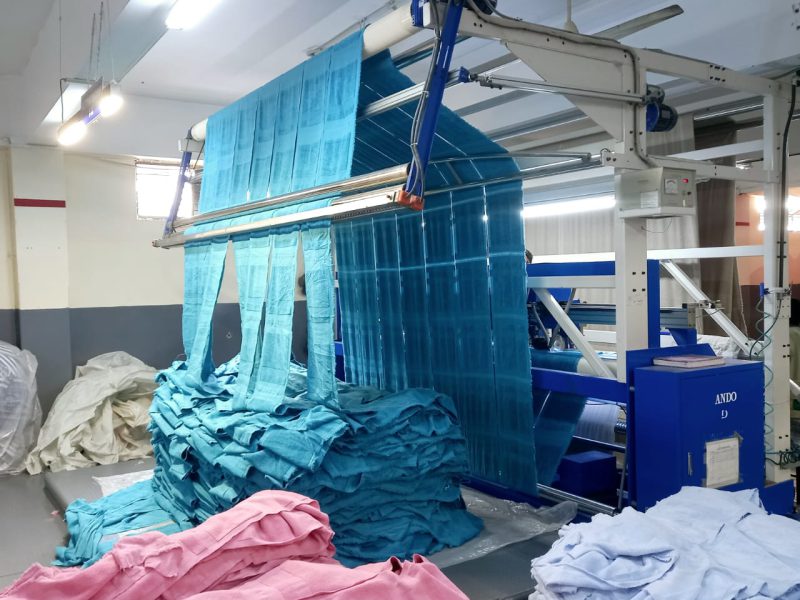
The towel manufacturing industry has changed significantly over the years. As customer expectations rise and textile manufacturers compete for better quality, faster production, and lower operating costs, relying entirely on manual processes is becoming increasingly difficult. Modern production facilities are turning toward automation to improve consistency and make better use of their workforce and machinery.
Towel production involves several finishing stages where accuracy matters. Cutting, slitting, hemming, sizing, stitching, and handling all need to work together smoothly. Even a small inconsistency in one stage can affect the final appearance of a towel. Automation helps manufacturers control these processes more accurately while creating a more predictable production flow.
For manufacturers looking to modernise these operations, Towel Automation machines can make a meaningful difference. These systems can automate important finishing tasks, reduce repetitive manual work, and help maintain consistent dimensions across large production runs. Texserco focuses on textile machinery and automation solutions designed to support manufacturers looking for greater efficiency and dependable production performance.
Why Automation Matters in Towel Manufacturing
Traditional towel production can involve a considerable amount of manual handling. Workers may need to measure fabric, position material, operate cutting equipment, guide fabric through stitching operations, and inspect finished pieces. While experienced workers can achieve excellent results, manual production naturally leaves more room for variation.
Automation changes this equation by giving manufacturers greater control over repetitive processes. Machines can follow programmed settings and perform specific operations consistently throughout a production run. This does not mean people become unnecessary. Instead, automation allows skilled employees to spend less time on repetitive physical tasks and more time supervising production, checking quality, maintaining equipment, and solving operational issues.
For larger towel manufacturers, this shift can be especially valuable because production volumes can be substantial. When the same process needs to be repeated thousands of times, even small improvements in speed and accuracy can have a noticeable effect on overall output.
Consistent Towel Sizing and Finishing
One of the most important benefits of automation is consistency. Customers expect towels to have uniform dimensions, clean edges, and reliable finishing. When towels coming from the same production batch vary in size or have inconsistent hems, the overall quality of the product can suffer.
Automated cutting and hemming systems help reduce these variations. Once the required settings are established, the machine can repeat the process according to those parameters. For example, automated length control can help produce towels with more consistent measurements. Automated slitting can maintain uniform widths, while automated hemming can help create a more consistent finished edge.
This consistency is valuable not only for product appearance but also for packaging, storage, inventory management, and customer satisfaction.
Faster Production Without Sacrificing Accuracy
Speed is another major reason textile manufacturers consider automation. Increasing production speed manually is not always practical. Workers can become tired during long shifts, and fatigue can eventually affect concentration and consistency. Machines, meanwhile, can perform repetitive operations continuously according to their programmed settings.
Modern towel automation equipment can support high-speed operations such as hemming, slitting, and cross-cutting. Some systems are designed to operate at speeds of up to 20 metres per minute, depending on the application and machine configuration. The real advantage is not simply producing more pieces per hour. It is creating a smoother production process where speed and consistency can work together.
Manufacturers should still evaluate their individual production requirements before choosing equipment. The ideal machine depends on towel type, fabric characteristics, production volume, required dimensions, and existing production-line setup.
Reducing Repetitive Manual Work
Towel finishing often involves repetitive movements. Measuring, cutting, positioning, folding, and stitching material over long production shifts can place considerable demands on workers. Automation can reduce the amount of repetitive work employees need to perform. Instead of manually controlling every stage, operators can monitor automated equipment and intervene when necessary.
This can create a better division of responsibilities within a production facility. Employees can focus more on machine monitoring, quality inspection, maintenance, material preparation, and production coordination.
Reducing repetitive tasks can also make production easier to organise. When machines handle predictable operations, supervisors have greater visibility into the process and can identify problems earlier.
Improving Material Utilisation
Fabric is one of the most important costs in textile manufacturing, which means unnecessary waste can quickly become expensive. Inconsistent cutting is one potential source of waste. If lengths are not measured accurately or cuts are not positioned properly, manufacturers may lose usable material.
Automated cutting and slitting equipment can help improve precision. Consistent measurement and programmed cutting can reduce unnecessary variation and help manufacturers use fabric more efficiently. The actual level of material savings depends on the production process, fabric type, machine configuration, and operating practices. Automation should therefore be viewed as a tool for improving control rather than a guarantee of a specific percentage of savings.
Better material utilisation also supports more organised production planning. When cutting patterns and dimensions are controlled more reliably, manufacturers can improve their ability to estimate material requirements.
The Role of Automated Hemming
Hemming is a critical part of towel finishing because it directly affects durability and appearance. A poorly finished hem can reduce the usable life of a towel. Loose stitching, uneven edges, or inconsistent seam placement can create quality issues that become noticeable after washing or repeated use.
Automated hemming systems are designed to make the process more consistent. Modern equipment can combine controlled feeding, stitching, and programmed operation to produce uniform hems across large production runs. Some automated hemming systems also use PLC controls and touch-screen interfaces, allowing operators to manage machine settings more conveniently.
For manufacturers producing towels in multiple sizes, automation can also simplify production changes. Once the appropriate settings are established, operators can adjust the machine for different production requirements without relying entirely on manual measurement.
Automated Slitting for Better Width Control
Slitting is another operation where accuracy matters. Towel fabric needs to be divided according to specific production requirements. If the width varies from one piece to another, the final product may not meet the required specification.
Automated slitting systems can control fabric measurement and cutting more consistently. This is particularly useful for high-volume production where the same operation is repeated throughout a shift. Better width control can also make subsequent finishing stages easier. When material enters the next process with predictable dimensions, the production line can operate more smoothly. For manufacturers producing different towel sizes or specifications, flexible machine settings can be particularly useful.
Cross-Cutting and Accurate Dimensions
Cross-cutting determines the final length of many towel products, making it an important stage in production. Manual cutting can work for smaller operations, but maintaining identical dimensions across large volumes becomes increasingly challenging. Automated cross-cutting systems can follow programmed measurements and perform repeated cuts with greater consistency.
Accurate cross-cutting helps create products that look uniform when packed and displayed. It can also reduce the amount of time workers spend measuring individual pieces. When combined with automated slitting and hemming, cross-cutting can become part of a more integrated towel-finishing workflow.
Better Production Control Through PLC Technology
Automation is not simply about motors and mechanical movement. Modern machinery can also use electronic controls to make production easier to monitor and manage. Programmable logic controllers, commonly known as PLCs, allow machines to operate according to programmed instructions. Touch-screen interfaces can provide operators with a clearer way to adjust settings and monitor operations.
This can improve production control because operators do not have to rely entirely on manual adjustments during every stage. Digital controls can also make troubleshooting and machine management more organised. When production settings are clearly defined, operators can work with greater consistency across different shifts.
For textile manufacturers, this is particularly useful when maintaining the same production standards across long operating periods.
How Automation Can Support Labour Efficiency
A common misconception is that automation simply means replacing workers. In reality, the effect can be more practical.
Automation allows manufacturers to use their workforce differently. Instead of assigning employees to repetitive cutting or hemming tasks throughout an entire shift, workers can supervise equipment and focus on areas that require human judgement.
This can include:
- Monitoring machine performance
- Inspecting finished towels
- Managing fabric preparation
- Handling production changes
- Performing routine maintenance
- Identifying quality problems
- Coordinating production schedules
The goal is to create a production environment where machines handle repeatable processes while people remain responsible for supervision, quality, and decision-making.
Quality Control Becomes Easier
Quality control is more effective when the production process itself is consistent. If every towel is produced using slightly different manual measurements, inspectors may need to deal with a wider range of variations. Automated equipment can reduce that variation by following predefined settings.
This creates a stronger foundation for quality inspection. Manufacturers can establish specifications for towel length, width, hem position, and other finishing requirements. Production teams can then monitor whether the machinery continues to operate within those specifications. Automation does not eliminate the need for quality control. Instead, it can make quality control more systematic.
Choosing the Right Automation Equipment
Not every towel manufacturer needs the same type of machinery. Before investing in automation, manufacturers should consider several factors. First, production volume matters. A small facility with limited output may have different requirements from a large export-oriented manufacturing operation. Second, manufacturers should consider the types and sizes of towels they produce. Different products can require different cutting, slitting, and hemming configurations. Third, fabric characteristics should be evaluated. Thickness, construction, weight, stretch, and finishing can all influence machine performance.
The existing production line should also be considered. New equipment should fit logically into the current workflow rather than creating an isolated process that introduces additional handling. Finally, operators and technical teams should be considered. A sophisticated machine is only valuable when employees can operate and maintain it effectively.
Why Technical Support Matters
Buying machinery is only one part of an automation project. Installation, machine setup, operator training, troubleshooting, maintenance, and technical support can all influence long-term performance.
A machine may have excellent specifications, but poor implementation can reduce its practical value. Manufacturers should therefore consider the complete support process when evaluating automation equipment. Texserco provides textile machinery and automation solutions with support covering areas such as consultation, installation, training, and ongoing technical assistance. Its website highlights more than two decades of experience and machinery installations across multiple countries.
For a manufacturer planning a move toward automated towel production, working with a technically capable machinery provider can make the transition more manageable.
When Should a Towel Manufacturer Consider Automation?
Automation makes the most sense when a manufacturer has a clear production problem to solve.
For example, automation may be worth considering when:
- Production volumes are increasing
- Manual cutting is causing inconsistent dimensions
- Hemming quality varies between operators
- Labour is heavily occupied with repetitive tasks
- Production targets are becoming difficult to meet
- Fabric waste needs better control
- Multiple shifts need consistent production standards
- The manufacturer wants to modernise an older production line
The decision should be based on actual production data rather than simply following an industry trend.
Manufacturers can compare current labour costs, production volumes, waste, downtime, quality issues, and maintenance requirements against the expected benefits of automation.
This approach provides a more realistic picture of whether an investment will deliver value.
Building a More Efficient Towel Production Line
Automation works best when individual machines are considered as parts of a complete production system. For example, cutting, slitting, and hemming should not be viewed as completely separate processes. Material movement between each stage affects productivity.
If one machine operates much faster than another, bottlenecks can appear. Similarly, if finished fabric needs excessive manual handling between stages, some of the benefits of automation can be lost. Manufacturers should therefore examine the complete workflow.
A well-planned production line can create smoother material movement, reduce unnecessary handling, improve production visibility, and make better use of available floor space. This is where proper planning becomes just as important as the machinery itself.
Maintenance and Operator Training
Even highly automated machinery needs proper care. Routine maintenance helps keep equipment operating reliably and can reduce the risk of unexpected downtime. Operators should understand basic machine functions, safety procedures, settings, and warning signals. Training is particularly important when introducing new equipment to an existing workforce. Employees should know how to operate the machine correctly and recognise when a technical issue requires attention.
Good training can also prevent avoidable operating mistakes. Manufacturers should establish maintenance schedules and keep important replacement parts and technical resources accessible where practical. Automation delivers the best results when technology, people, and maintenance practices work together.
The Long-Term Value of Towel Automation
The benefits of automation should not be measured only through immediate production speed. A well-planned system can influence several areas simultaneously. Consistent production can improve product quality. Better cutting accuracy can support material efficiency. Reduced repetitive work can allow employees to focus on higher-value responsibilities. Improved controls can make production easier to monitor.
Over time, these improvements can contribute to a more predictable manufacturing environment. Automation can also help manufacturers prepare for future growth. As production volumes increase, having a more controlled finishing process can make it easier to scale operations without increasing manual work at the same rate.
Final Thoughts
Towel manufacturing is becoming increasingly focused on precision, efficiency, consistency, and smarter production management. Manual processes still have an important role, but relying on them for every repetitive operation can make it harder for manufacturers to maintain high output and consistent quality. Automation offers a practical way to improve key finishing stages such as hemming, slitting, and cross-cutting. With accurate controls, consistent measurements, and reduced repetitive work, manufacturers can create a more organised production process.
The most important point is that automation should be selected according to the manufacturer’s actual needs. Production volume, towel specifications, fabric characteristics, available space, workforce, maintenance capabilities, and long-term growth plans should all be considered before making an investment. For manufacturers exploring modern textile automation, Texserco offers a range of towel finishing machinery and broader textile production solutions, with its current range including automated hemming, slitting, and cross-cutting equipment.
When the right equipment is combined with proper planning, skilled operators, and reliable technical support, towel automation can become more than a machinery upgrade. It can become an important step toward building a faster, more consistent, and better-controlled textile production operation.