
Textile production demands absolute precision, especially when handling complex structural weaves like pile fabrics. To understand how material is divided during manufacturing, one must evaluate the physical forces acting upon the individual threads. Woven loops require specialized handling to prevent structural failure along the severed edge. Traditional separation techniques rely on mechanical force, employing rotary discs, stationary blades, or high-speed shears to slice through the interlacing web. This physical contact applies immense shear stress to both the warp and weft components, physically forcing the fibers apart through structural deformation.
Alternative modern techniques introduce acoustic vibrations to achieve separation without relying solely on mechanical sharpness. These systems utilize a high-frequency generator coupled with a transducer and a specialized horn to focus intense acoustic energy into a narrow localized zone. As the fabric passes through this zone, the molecular structure experiences rapid compression and expansion cycles, generating internal friction. This friction elevates the localized temperature within milliseconds, causing thermoplastic fibers within the fabric blend to soften and fuse. The mechanical stress is minimized, replacing raw cutting force with a controlled thermal separation that alters the structural state of the fabric border.
Understanding these foundational differences allows engineers to optimize production lines based on fiber composition. Purely mechanical systems excel when processing uniform organic fibers that lack thermal responsiveness. Acoustic vibrational systems offer an entirely different pathway by utilizing energy transformation to achieve structural separation. Each method alters the textile border through distinct physical phenomena, dictating how the material behaves during subsequent processing steps and throughout its consumer lifespan.
Analyzing Material Degradation and Fraying Mechanisms
Edge stability remains a critical quality metric in commercial fabric fabrication. When a mechanical blade shears through a complex loop structure, it leaves behind open yarn ends that lack structural support. The interlocking tension holding the weft and warp threads together is instantly released along the cut line. Without an immediate stabilizing mechanism, these exposed threads slide out of the woven matrix during handling or washing, leading to progressive unraveling. This degradation forces manufacturers to implement secondary processing steps, such as dense overlock stitching or deep hemming, to secure the loose borders.
When using high-frequency vibrational separation, the edge behavior changes fundamentally due to immediate fiber consolidation. The localized thermal energy melts synthetic fibers, transforming them into a stable polymer matrix that encapsulates neighboring natural fibers. Instead of a loose, unstable border, the material receives a clean, sealed perimeter that resists mechanical unraveling. Microscopic analysis reveals that the fused edge forms a continuous bead, effectively anchoring every individual thread in place and preventing the structural slippage that typically leads to fraying.
The elimination of immediate fraying alters the entire downstream workflow. Manufacturers can bypass heavy edge-reinforcement steps or reduce the width of protective hems, saving substantial amounts of material. By examining the degradation patterns under various stress conditions, it becomes evident that sealing the perimeter during the separation phase offers superior resistance to mechanical wear compared to raw mechanical shearing. This structural stability ensures that the finished product retains its dimensional integrity through extensive industrial laundering cycles.
Thermal Properties and Synthetic Blend Reactions During Fabrication
The thermal dynamics of fabric separation depend heavily on the material composition of the yarn. Modern textile products frequently incorporate synthetic polymers, such as polyester and polyamide, alongside natural fibers to enhance absorption and durability. These synthetic materials possess specific glass transition temperatures and melting points that dictate their behavior under thermal stress. When acoustic energy is applied, these polymers undergo a phase transition, shifting from a solid crystalline or amorphous state into a viscous liquid state that flows across the fiber boundary before rapidly solidifying.
Unlocking the full potential of thermal separation requires precise regulation of the energy input. Excessive energy delivery causes overheating, turning the melted polymer into a hard, rigid bead along the edge of the fabric. This scratchy border degrades the tactile quality of consumer products, making them unsuitable for sensitive applications. Conversely, insufficient energy input results in incomplete fusion, leaving portions of the synthetic matrix unbonded and vulnerable to fraying. Achieving the perfect balance requires tuning the vibrational frequency and mechanical pressure to match the specific synthetic percentage within the yarn blend.
When natural fibers like cotton are mixed into the blend, they do not melt under thermal stress; instead, they remain structurally intact while the surrounding synthetic liquid wraps around them. This creation of a composite edge matrix relies entirely on the precise distribution of heat within the cutting zone. Mechanical separation avoids these thermal complexities entirely, but fails to exploit the beneficial material transformations that synthetic polymers offer. Managing these thermodynamic interactions allows producers to customize edge properties for specific applications, ranging from ultra-soft consumer items to rugged industrial cloths.
Operational Velocity and Long-Term Blade Wear in Large-Scale Production
When evaluating factory throughput, analyzing Ultrasonic vs Traditional Towel Cutting Methods reveals deep operational disparities regarding tool degradation and line speed. Mechanical systems utilizing rotary or stationary steel knives depend entirely on the sharpness of the cutting edge to achieve separation. As these blades process miles of dense, abrasive fabric, the cutting edge experiences continuous friction, leading to microscopic chipping and rounding. This dulling phenomenon increases the required cutting force, degrades edge quality, and demands frequent production shutdowns for blade sharpening or complete tool replacement.
In stark contrast, vibrational separation tools do not rely on physical sharpness to divide the material. The acoustic horn remains relatively blunt, utilizing high-frequency oscillation to create localized thermal separation. Because the tool does not wedge its way through the fibers using raw mechanical force, the physical wear on the component is exceptionally low. This structural longevity translates into extended production campaigns without the need for frequent calibration or maintenance intervention, drastically reducing machine downtime in high-volume manufacturing facilities.
Operational speed comparisons show a nuanced relationship between the two methodologies. Mechanical cutting can achieve incredibly high linear velocities when processing pure, non-blended organic fabrics because the process is instantaneous and does not require thermal dwell time. Vibrational separation, however, requires the fabric to spend a precise microsecond fraction beneath the acoustic horn to ensure complete polymer melting and sealing. If the material moves too rapidly, the thermal energy cannot accumulate sufficiently, leading to intermittent bonding. Modern automated systems solve this challenge by using high-efficiency generators that sustain intense energy output, allowing vibrational lines to match the demanding throughput requirements of modern industrial facilities.
Energy Consumption Profiles and Resource Efficiency Metrics
Evaluating the financial impact of manufacturing technologies requires a thorough review of utility consumption patterns. Mechanical cutting systems require continuous electrical energy to drive powerful electric motors that spin heavy cutting discs or move mechanical assemblies. These motors draw a stable, predictable amount of power throughout the production shift, regardless of whether fabric is continuously passing through the blades. Over long operational periods, the cumulative energy expenditure becomes a significant component of the facility’s overhead costs.
Acoustic vibrational systems function on a different energy delivery model. The high-frequency generator converts standard grid electricity into ultrasonic electrical energy, which is then transformed into mechanical vibrations by the transducer. This process involves sophisticated electronics that optimize power delivery based on the resistance encountered by the acoustic horn. Crucially, modern vibrational units can operate in a pulsed or load-sensing mode, meaning they only draw maximum power when material is actively passing beneath the horn. When the line pauses or gaps occur between fabric pieces, the energy consumption drops to a minimal standby level.
Analyzing the total resource efficiency reveals that while vibrational equipment may have a higher peak power rating, its smart energy utilization often results in lower overall kilowatt-hour consumption per unit of finished product. Additionally, the elimination of secondary heating or sealing processes further reduces the total energy footprint of the production line. By matching energy deployment directly to the material interaction zone, manufacturers can achieve substantial utility savings while optimizing their carbon footprint in an increasingly cost-conscious industrial landscape.
Material Yield Optimization and Waste Minimization Strategies
Material conservation directly influences the profitability of textile manufacturing operations. Mechanical separation processes generate a substantial amount of airborne lint and loose fiber fragments as the blade forces its way through the woven yarn. This loose material must be continuously collected by powerful vacuum systems to prevent clean-room contamination and protect worker health. This accumulated lint represents a direct loss of raw material that cannot be reclaimed, reducing the overall yield of the manufacturing run.
Vibrational cutting eliminates this waste stream by capturing loose fibers during the separation phase. As the acoustic energy divides the fabric, the instantaneous thermal bonding fuses the yarn ends together, preventing the liberation of loose fibers or lint. The production environment remains exceptionally clean, reducing the maintenance burden on vacuum filtration systems and eliminating material loss. This clean separation ensures that every ounce of raw fabric remains part of the structural matrix of the finished product.
Furthermore, traditional mechanical cutting requires significant fabric margins to accommodate the wide hems needed to cover raw, fraying edges. This excess fabric represents a hidden waste factor that accumulates over thousands of production cycles. Fused borders require minimal hem allowance, and in some applications, the sealed edge can remain completely unhemmed without sacrificing durability. This capacity to reduce or eliminate hem margins allows factories to extract more finished units from every bolt of raw fabric, significantly optimizing material yield and reducing total manufacturing waste.
Advanced Engineering Solutions for Integrated Textile Manufacturing Lines
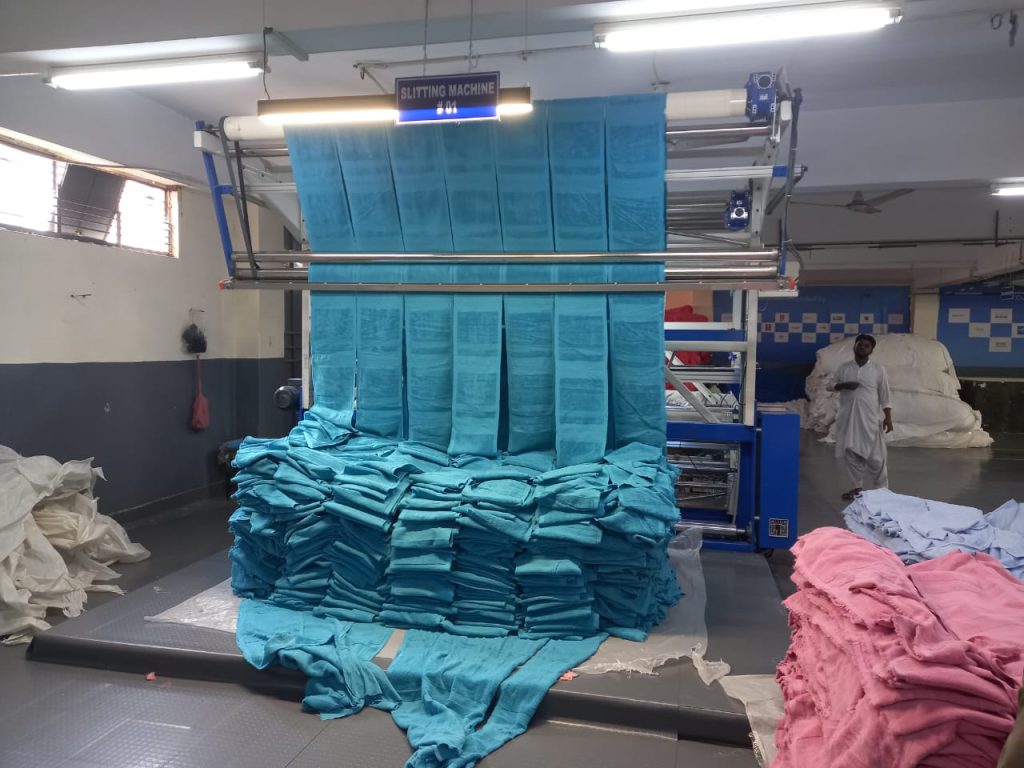
Modern textile facilities achieve peak profitability by transitioning away from isolated machinery toward fully integrated, automated production lines. Advanced engineering has led to the development of sophisticated automated slitting and cross-cutting systems that streamline the entire fabrication workflow. These high-performance installations utilize cutting-edge electronic fabric guidance systems equipped with photo-electronic sensors that continuously monitor material alignment. By automatically adjusting the position of independent cutters in real time, these systems ensure that fabric strips are divided precisely down the center of pile selvages, maintaining absolute dimensional accuracy across high-volume manufacturing runs.
Implementing these integrated automation solutions allows manufacturers to significantly accelerate production velocities, with variable electronic speed controls easily regulating throughput from thirty to sixty meters per minute depending on fabric quality. This level of automation replaces traditional, labor-intensive manual processes, compressing what used to take four to six hours of manual labor into a single hour of highly efficient, machine-driven production. The underlying technology focuses heavily on resource conservation, utilizing advanced programmable logic controllers and precision inverters to optimize power usage, thereby drastically lowering utility expenses related to gas, electricity, steam, and water.
The physical architecture of these modern automation systems is engineered for rugged durability and continuous heavy-duty operation. Every component is built to exacting specifications, utilizing premium materials that minimize mechanical vibration and wear over millions of production cycles. By combining precise fabric alignment, automated length measurement, and high-speed cross-cutting into a unified platform, these advanced systems guarantee optimal product consistency and international-grade finishing quality. This comprehensive approach to manufacturing automation empowers textile businesses to satisfy strict international standards while maximizing their operational efficiency and investment returns.
Final Synthesis of Modern Fabrication Methodologies
The evolution of fabric separation technology highlights a clear transition from traditional mechanical force to precise energy-driven automation. Comparing the physical principles, tool degradation patterns, and material outcomes reveals that each methodology possesses distinct characteristics suited for specific manufacturing demands. While mechanical blades offer simple operation and high speeds on raw organic fibers, they introduce challenges regarding edge stability, tool wear, and material waste that can hinder long-term operational efficiency.
Embracing advanced acoustic separation and integrated automated workflows allows modern production facilities to overcome these historical limitations. The capacity to divide and seal fabric edges simultaneously addresses the fundamental challenge of edge fraying, unlocking new opportunities for material conservation and streamlined downstream processing. As production requirements become more stringent, selecting the appropriate cutting and finishing methodology becomes a defining factor in achieving the balance between high throughput and premium product quality.
Ultimately, the optimization of manufacturing facilities relies on the seamless alignment of material properties, machine capabilities, and energy efficiency. Implementing automated systems equipped with precision tracking and smart energy management ensures consistent, international-grade results across extensive manufacturing campaigns. Elevating the standard of towel production through these advanced technological applications allows manufacturers to secure a resilient, cost-effective, and highly competitive position in the global textile market.