
Unplanned downtime on an automated terry cloth processing floor creates a cascading failure across the entire production schedule. When high-volume length hemming, slitting, or cross-cutting lines stall due to mechanical binding or sensor faults, the financial consequences mount instantly. Industrial automated sewing lines operate under exceptionally harsh conditions. Heavy, abrasive cotton loops, constant lint generation, high-velocity fabric feed rates, and shifting tension parameters constantly threaten the mechanical tolerances of your machinery. A minor failure in a drive roller or a pneumatic cylinder does not just stop one towel; it bottlenecks raw material processing, forces labor teams into idle standby, and ultimately results in missed shipping deadlines and compromised margins. The structural elasticity and thickness of terry cloth amplify these industrial challenges, requiring absolute mechanical uniformity to prevent fabric slippage and irregular hem lines. Transitioning away from a reactive, break-and-fix repair model toward an analytical, predictive framework directly impacts the profitability and throughput of your facility.
Facilities that wait for a rotary blade to chatter or a sewing head to skip stitches before intervening inherently accept high rates of fabric waste and component destruction. True process optimization demands deep technical discipline and a granular focus on the physical forces interacting within your high-speed platforms. To systematically eliminate micro-stops and keep your production lines operating at maximum capacity, implementing Maintenance Best Practices for Towel Automation Equipment is vital. Managing highly engineered, high-throughput systems such as Bando and Alpha platforms requires precise calibration across every moving sub-assembly. By actively managing the tension control, pneumatic stability, and cutting geometries of these lines, plant managers can directly prevent the mechanical drift that leads to poor structural seams, inconsistent cross-cuts, and premature hardware failure.
Operational Gains and Quantifiable Plant Metrics
Moving from reactive maintenance to a highly structured mechanical oversight program transforms unpredictable manufacturing floors into stable, high-yield operations. Implementing stringent calibration routines yields specific, measurable advantages that directly improve operational efficiency and cost control.
- Achieving a 35% reduction in unplanned line stoppages by identifying worn bearings and degrading synthetic transport belts before they cause catastrophic operational failures.
- Securing a 12% optimization in raw fabric yield by eliminating structural slippage across the drive rollers, which guarantees precise, straight cuts and prevents the loss of expensive raw pile inventory.
- Maintaining a 92% baseline machine availability rate across consecutive production shifts through the proactive replacement of high-wear consumables like rotary knives and presser foot pads.
- Sustaining a rigorous and consistent 8 stitches per inch standard across all border hems by eliminating thread tension fluctuations and synchronizing looper timing.
Calibrating Transport Mechanisms and Fabric Feeding
The absolute foundation of automated towel processing is the structural integrity of the fabric transport system. If the primary drive rollers or the synthetic tracking belts experience even microscopic surface degradation, the terry pile will instantly begin to track unevenly. Because terry cloth is inherently heavy and heavily textured, it demands massive grip strength from the rollers to move smoothly through the cutting and hemming zones. Over thousands of operational hours, the aggressive surface friction dulls the synthetic rubber durometer on your drive units. Furthermore, textile finishing agents, softeners, and residual dyes embed themselves into the porous surfaces of the transport belts, causing them to glaze over and lose their natural tack.
Restoring and maintaining this critical traction requires systematic intervention. Plant technicians must inspect drive roller surfaces using durometer gauges to ensure the shore hardness remains within the original equipment manufacturer parameters. When rollers harden, they lose their ability to compress the terry loops, leading to lateral skewing as the fabric approaches the high-speed sewing head. Technicians must clean these roller surfaces daily using non-residual, industrial-grade solvents that strip away accumulated sizing agents without inducing dry rot in the polymer components. Additionally, tension rollers must be dynamically calibrated using a digital force gauge to ensure identically distributed downforce across the entire width of the fabric web. Unequal gripping pressure along the web creates mechanical stretch, which results in wavy, distorted hems once the fabric recovers its natural shape after stitching.
Managing Precision Cutting and Slitting Hardware
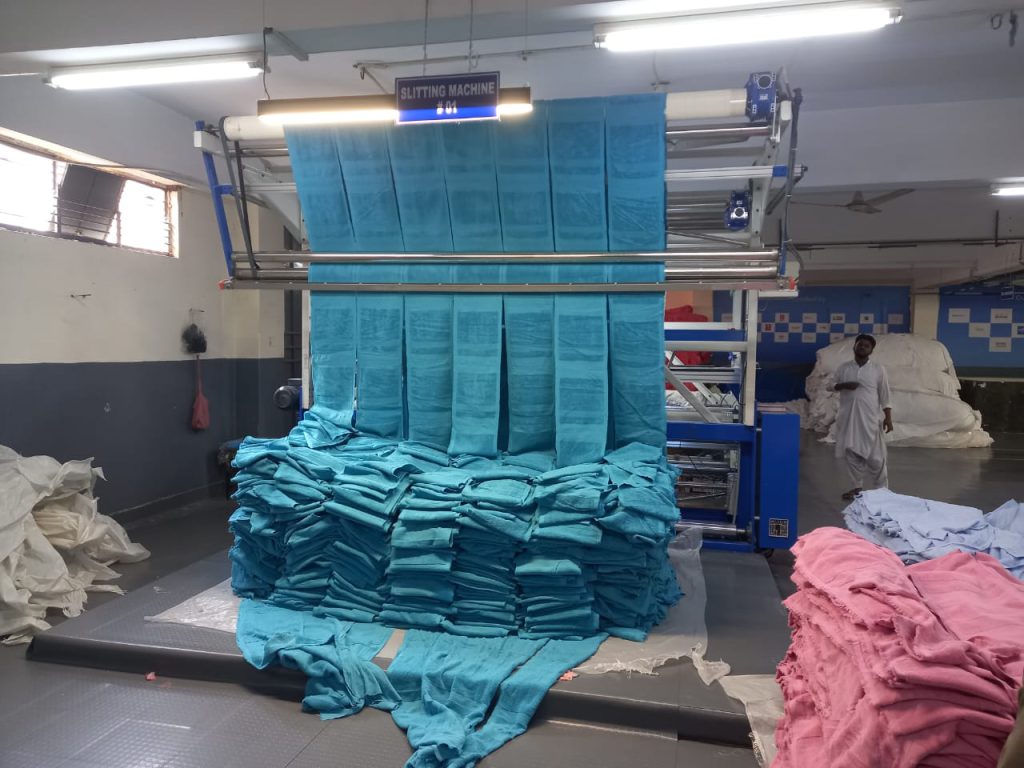
Automated slitting and cross-cutting sub-systems absorb intense mechanical punishment. Processing continuous, multi-axis terry webs at speeds approaching 20 meters per minute generates severe localized friction, rapidly dulling cutting edges and inducing microscopic blade chattering. The circular slitting knives and the hardened steel cross-cut shear bars require rigorous geometric verification to function correctly. Even a fractional misalignment in the blade angle will tear the raw cotton weave rather than slicing it cleanly, leaving frayed, loose threads that instantly unravel during the first commercial laundering cycle.
Plant operators must move beyond merely checking a blade for surface sharpness. A highly effective technical program utilizes dial indicators to measure both axial and radial runout on the circular knife spindles down to the micron level. When a blade’s runout exceeds specified tolerances, the eccentric rotation places massive, uneven stress on the internal spindle bearings. This vibration creates a rippled cut edge and ultimately forces the bearing track to shatter under load. To control thermal expansion, operators must ensure that continuous blade lubrication systems are dispensing the exact micro-droplet volume of low-viscosity, non-staining technical oil. This lubrication creates a microscopic barrier that prevents synthetic blend fibers from melting under extreme friction and fusing into the blade’s cutting geometry.
Optimizing Pneumatic Actuation and Tensioning Dynamics
Pneumatic cylinders, grippers, and air knives dictate the tactile, physical movements of modern towel automation hardware. These components drive the rapid sequencing required for high-speed cross-hemming and fabric waste extraction. However, pneumatic components are entirely reliant on the continuous supply of stable, hyper-clean compressed air. Industrial textile environments frequently suffer from fluctuating factory air pressure, which subtly alters the stroke time of pneumatic cylinders. A delay of merely milliseconds in a cylinder’s response time throws off the complex synchronization between the fabric feeding mechanism and the precise moment the cross-cut shear activates, resulting in ruined product dimensions.
Securing pneumatic reliability requires installing highly sensitive, high-flow pressure regulators directly at the machine intake, isolating the automation line from the fluctuations of the broader factory. Operating pressures must be locked exactly at the specified parameter, typically around 6.0 bar, to ensure consistent force delivery. Upstream from the primary manifold, the system requires a multi-stage filtration loop equipped with automated mechanical water drains and highly efficient oil-coalescing filters. Ambient humidity in textile plants naturally condenses inside air compressors; if this water vapor reaches the machine, it instantly begins rusting internal aluminum spool valves. This internal corrosion causes severe stiction, where valves fail to shift under electrical command. Weekly diagnostic testing of all localized cylinder seals is mandatory to detect sub-surface air blow-by, ensuring the mechanical gripper assemblies retain rigid physical control over the fabric during the fastest operational cycles.
Combating Abrasive Particulate and Lint Accumulation
The mechanical action of slitting, cutting, and manipulating terry cloth generates a massive volume of airborne cotton particulate. This industrial lint is the primary enemy of automated machinery. It aggressively settles into open linear guide rails, coats optical sensor lenses, and packs into the threads of precision ball screws. When this highly absorbent cotton dust mixes with bearing lubrication, it transforms into a dense, highly abrasive sludge that dramatically accelerates the wear of moving metal components and increases electrical resistance inside control cabinets. Defeating lint requires an aggressive, multi-tiered extraction and mitigation strategy.
Automated, high-velocity vacuum hoods must be strategically positioned directly over the rotary slitting knives and the needle plates to capture cotton debris at the exact point of generation before it can become airborne. This active extraction must be supplemented by rigorous, manual high-pressure air purging routines at the conclusion of every operational shift. Maintenance personnel must focus specifically on clearing out optical tracking sensors, photo-eye reflectors, and the delicate slotted discs inside rotary encoders. Even a microscopic layer of lint obstructing a photo-eye will block the infrared beam, causing the programmable logic controller to miss crucial cutting marks, register false tracking errors, and trigger sudden emergency line stops.
Synchronizing High-Speed Sewing Head Kinematics
The industrial sewing head serves as the absolute core of the length hemming and cross-hemming processes. Operating consistently at several thousand revolutions per minute requires flawless timing synchronization between the descending needle bar, the elliptical motion of the feed dog, and the rapid rotation of the looper mechanism. Terry cloth exacerbates the difficulty of this timing due to the sudden transitions from single-ply fabric to massive, heavily folded border seams. Hitting these thick structural seams at high speed places extreme lateral stress on the needle geometry.
Technicians must systematically check needle deflection and lateral play using precision feeler gauges. Natural bending occurs during high-speed operation, which slowly alters the precise distance between the needle scarf and the looper point. If this gap widens by even a fraction of a millimeter, the looper will fail to catch the upper thread loop, resulting in skipped stitches and weak structural seams. Technicians must verify looper timing clearances directly against original manufacturer specifications every single week, adjusting the loop-taker timing to pass the needle with near-zero clearance without risking a high-speed metal collision. Furthermore, operators must actively inspect all thread guides, eyelets, and tension discs for surface grooving. Highly abrasive industrial polyester thread easily cuts micro-grooves into metal tensioners; once these grooves form, thread tension becomes impossible to regulate, leading to consistent thread snapping under maximum operating speeds.
Thermal Regulation of Electronic Control Systems
The rapid mechanical orchestration of these lines relies entirely on the continuous health of sensitive electronic components, including Programmable Logic Controllers (PLCs), Variable Frequency Drive (VFD) inverters, and Human-Machine Interface (HMI) touchscreens. These low-voltage control systems are highly vulnerable to the high ambient temperatures, electromagnetic interference, and sudden power fluctuations inherent to large-scale textile manufacturing environments. When a VFD overheats due to poor cabinet ventilation, it instantly begins throttling power to the drive motors, causing erratic acceleration profiles that tear the fabric web.
To protect these critical electronic brains, plant managers must guarantee that all heavy-gauge control cabinet doors remain tightly sealed to prevent lint ingress, and that all integrated forced-air cooling fans and heat exchangers are fully functional. If internal cabinet temperatures are permitted to exceed optimal operating ranges, the internal capacitors within the VFD inverters will prematurely degrade. Furthermore, technicians must conduct quarterly torque checks on all terminal block wiring connections. The intense, continuous mechanical vibration of the hemming equipment naturally loosens screw terminals over time. A loose ground wire or a vibrating communication cable will cause intermittent packet loss across Ethernet or RS-485 networks, resulting in phantom machine faults that are notoriously difficult to diagnose. Regularly backing up all customized PLC logic parameters and HMI interface data to secure, external solid-state storage guarantees that your technical team can instantly restore machine operations following a catastrophic electrical surge.
Preserving Linear Motion and Actuation Pathways
The smooth lateral movement of cutting assemblies and sewing heads depends entirely on the condition of linear guide rails and ball screw assemblies. Operating in a lint-heavy environment forces maintenance teams to carefully evaluate their lubrication strategies. Utilizing standard, highly tacky industrial greases particularly those containing heavy additives like molybdenum disulfide creates a disastrous environment for textile machinery. Tacky grease acts as a magnet for airborne cotton particulate, quickly creating a solid, hardened paste that blocks the recirculation channels within the linear bearing blocks.
Instead, technicians must deploy specialized, lithium-soap-based greases fortified with advanced anti-oxidants and rust inhibitors that are specifically engineered for high-speed, low-load automation. These greases maintain a low base oil viscosity, allowing the ball bearings to glide freely without attracting massive amounts of environmental debris. To maintain the integrity of these guide rails, technicians must perform complete solvent washouts of the bearing tracks periodically, completely removing degraded, lint-contaminated grease before reapplying the correct volume of fresh lubrication. This disciplined approach prevents the linear assemblies from binding, ensuring the cutting heads actuate instantly and smoothly every time the PLC triggers a rapid cross-cut sequence.
Final Summary
Maintaining automated towel processing equipment at peak throughput requires a transition from reactive firefighting to a culture of technical discipline. When high-volume length hemming, slitting, and cross-cutting systems are backed by a structured maintenance framework, the entire manufacturing floor stabilizes. Systematically addressing fabric transport friction, cutting blade geometries, pneumatic stability, and lint mitigation directly prevents the micro-stops that erode plant profitability. Investing the technical effort to calibrate these highly engineered Bando and Alpha platforms yields measurable dividends: minimized fabric waste, preserved hardware lifespans, and consistent export-level stitch quality. By protecting the mechanical and electronic sub-systems from the harsh realities of the textile environment, your facility secures the continuous, high-velocity output necessary to meet demanding shipping schedules and protect operating margins. Peak performance is not an accidental milestone; it is the direct result of deliberate, precise engineering oversight.