
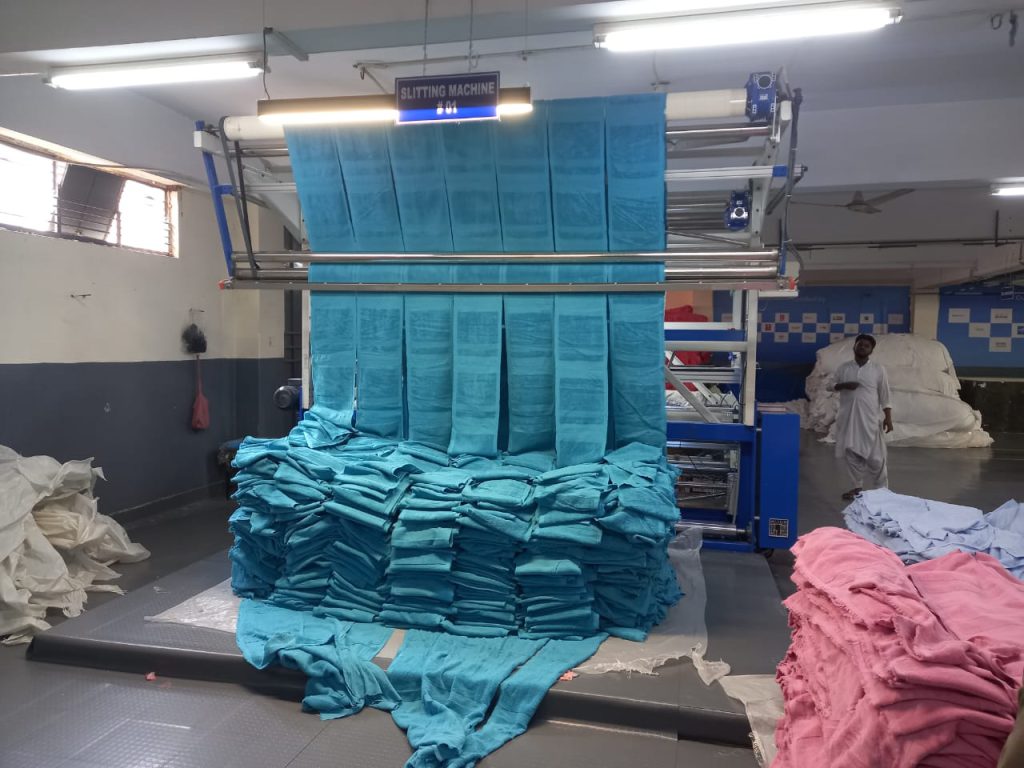
Commercial processing facilities face a relentless bottleneck at the finishing line. While high-capacity tunnel washers and multi-stage dryers process thousands of pounds of linen per hour, the post-drying phase frequently stymies operational throughput. Manual sorting, shaking, and folding of terry cloth items create a labor-dense environment susceptible to human error, physical fatigue, and erratic output quality. This operational drag directly compromises a facility’s ability to meet stringent turnaround times for hospitality, healthcare, and gym clients.
The physical strain of repetitive manual manipulation leads to high employee turnover and escalating worker compensation claims. When operators spend their shifts manually squaring corners and sorting variable pile thicknesses, individual productivity naturally degrades as the hours progress. This variance introduces inconsistent bundle counts and uneven stacks, which ultimately complicate transport logistics and dissatisfy end-use customers who demand uniformity in their delivered linen packages.
To counter these systemic overheads, forward-thinking plant managers are implementing advanced mechanical sorting and precise folding machinery. Integrating Towel Automation within the finishing department shifts the operational paradigm from variable manual throughput to a predictable, continuous mechanical cadence. This transition stabilizes hourly production metrics, drastically reduces the required headcount on the clean side of the plant, and ensures that every piece of terry cloth conforms to exact dimensional standards regardless of fabric weight.
Overcoming High Labor Turnover and Processing Bottlenecks
Industrial laundries traditionally absorb massive overhead costs within the dry-fold department due to high physical wear on staff. Employees tasked with manual processing handle thousands of heavy, damp, or dry towels daily, leading to repetitive strain injuries and a perpetually unstable workforce. The direct consequence of this high turnover is a continuous, costly cycle of onboarding and training, alongside a unpredictable daily processing capacity that leaves plants vulnerable during peak seasonal demands.
Beyond the human element, manual folding introduces severe operational variability that disrupts downstream logistics. When human operators fold items, the final dimensions of the stacks inevitably fluctuate based on fatigue levels and individual techniques. These mismatched dimensions cause unstable cart loading, inefficient use of delivery vehicle space, and frequent customer complaints regarding messy presentations upon delivery.
By replacing manual manipulation with sophisticated, sensor-driven folding systems, facilities establish a stable, machine-paced workflow that eliminates human variability. Modern finishing systems automatically accommodate various fabric dimensions, pile heights, and moisture retention levels without requiring manual adjustments or halting production lines. This mechanical stability allows plant managers to reallocate human labor to critical quality control areas, transforming a historically volatile department into a highly predictable, high-yield asset.
Quantifiable Gains via Mechanical Precision
Transitioning from manual dry-fold lines to automated finishing systems yields immediate, measurable improvements across all core operational KPIs. Facilities that eliminate manual sorting and folding see a drastic shift in resource allocation, utility efficiency, and daily volume capacity.
- Labor Efficiency Gains: Automated systems allow a single operator to feed pieces continuously, achieving a production rate equivalent to four or five manual folders, which translates to a 75% reduction in localized labor costs.
- Throughput Consistency: Mechanical systems maintain a steady processing speed of up to 1,200 pieces per hour, completely independent of shift duration, eliminating the afternoon productivity slumps common in manual operations.
- Logistical Optimization: Uniform stack heights and tightly squared edges compress the physical volume of processed linen, allowing facilities to maximize delivery truck payloads by up to 20% due to superior cart packing density.
- Floor Space Reclamation: Consolidating multiple manual folding tables into a single, compact mechanical footprint frees up valuable square footage for additional wash-room or ironer equipment.
Technical Synchronization of Sorting and Folding Mechanisms
Modern dry-fold machinery relies on an interconnected network of optical sensors, microprocessors, and pneumatic components to process mixed linen loads without stopping. As an operator places an item onto the inlet conveyor, specialized sensors immediately detect the length, width, and thickness of the piece. This real-time diagnostic capability allows the system to instantaneously calculate the exact folding parameters required for that specific item profile.
Pneumatic pulsed air jets execute the primary and secondary folds with extreme precision, avoiding the mechanical wear associated with traditional folding blades. This air-blast technology handles delicate microfibers and heavy-duty cotton bath sheets with equal efficacy, ensuring crisp edges without causing structural degradation to the selvages or hems. The entire process occurs while the item is in motion, maintaining continuous kinetic energy and preventing the jams associated with manual sorting errors.
Furthermore, these systems feature advanced diagnostic software that monitors pile thickness to identify stray items, such as rags or napkins, that may have bypassed the initial sorting phase. When an anomalous item is detected, the machine automatically routes it to a reject bypass chute without halting the primary folding cycle. This automated rejection ensures that only premium-quality, correctly dimensioned linens reach the final stacking and bundling phases.
Maximizing Operational Lifespan and Mitigating Downtime
The implementation of heavy-duty mechanical solutions requires a rigorous approach to preventive maintenance to safeguard the initial capital investment. Because these machines operate at high speeds in environments filled with lint and ambient moisture, daily maintenance protocols are essential for preventing premature component wear. Microscopic textile fibers can quickly accumulate within pneumatic valves and optical sensor housings, which can distort sensor readings and cause misfolds if left unaddressed.
Implementing an automated lint-evacuation system alongside scheduled daily blow-downs keeps critical internal electronics and mechanical pathways clean. Plant engineers must prioritize regular lubrication of primary drive chains and verify the calibration of pressure regulators to ensure the pneumatic folds remain crisp and uniform. Tracking these metrics through digital maintenance logs allows teams to anticipate component fatigue and replace wearable items during scheduled plant shutdowns.
Using high-grade synthetic lubricants and robust, industrial-grade components reduces the frequency of emergency interventions and minimizes the total cost of ownership over the machine’s life cycle. When a facility pairs heavy-duty engineering with disciplined maintenance practices, the equipment delivers decades of reliable service. This structural longevity ensures the plant maintains a highly competitive operational cost per pound, protecting profit margins against rising energy and labor costs.
Specialized Textile Solutions for Industrial Operations
Optimizing the finishing line requires a holistic view of the entire processing ecosystem, starting with the intrinsic quality of the commercial textiles themselves. Premium commercial linens are specifically engineered to withstand the mechanical stress of high-velocity automated feeders, continuous pneumatic folding, and industrial chemical processing. Selecting textiles with reinforced selvages and high-tensile cotton blends ensures the fabric retains its structural integrity through hundreds of intensive wash and dry cycles.
High-grade commercial terry cloth features a balanced weave construction that minimizes shrinkage and distortion, allowing the optical sensors on automated folding lines to consistently map the dimensions of the fabric. When textiles resist warping and edge-curling, the mechanical folding arms can execute precise geometric folds without requiring manual repositioning or causing frequent machine stoppages. Investing in industrial-grade linens directly enhances the efficiency of automated machinery, creating a seamless workflow from the wash wheel to the delivery cart.
Our specialized commercial laundry solutions provide facilities with the durable, high-performance textiles needed to maximize the efficiency of advanced finishing systems. By sourcing linens designed explicitly for high-speed mechanical environments, plants reduce reject rates, eliminate premature fabric tearing, and deliver a consistently exceptional product to their end users. Aligning premium material sourcing with automated processing technology establishes a highly efficient, reliable, and profitable commercial laundry operation.
Optimizing Commercial Processing
The transformation of the modern dry-fold department relies on eliminating manual bottlenecks, stabilizing daily throughput, and deploying industrial-grade textiles optimized for high-speed mechanical processing. Moving away from manual sorting and folding allows commercial laundries to insulate themselves from labor shortages, drastically lower operational costs, and deliver perfectly uniform linen packages. Embracing these advanced systems establishes long-term financial resilience and positions a facility as a highly reliable partner within the competitive commercial textile marketplace. Implementing these modern technologies ensures every phase of production operates at peak efficiency, safeguarding margins and supporting scalable business growth. For more details on industrial standards and textile performance, consult the global benchmarks detailed by the international laundry association frameworks.
Final Summary
The transformation of the modern dry-fold department relies on eliminating manual bottlenecks, stabilizing daily throughput, and deploying industrial-grade textiles optimized for high-speed mechanical processing. Moving away from manual sorting and folding allows commercial laundries to insulate themselves from labor shortages, drastically lower operational costs, and deliver perfectly uniform linen packages. Embracing these advanced systems establishes long-term financial resilience and positions a facility as a highly reliable partner within the competitive commercial textile marketplace.
Integrating specialized equipment allows management to capture reliable, real-time data regarding hourly output and operator efficiency. This transparent tracking removes the guesswork from shift planning and helps plant managers forecast utility costs and labor needs with pinpoint accuracy. Consequently, the facility transforms from a reactive environment into a proactive, highly optimized production center capable of scaling up volumes seamlessly during peak operational seasons.
Implementing these modern technologies ensures every phase of production operates at peak efficiency, safeguarding margins and supporting scalable business growth. When machinery and high-durability textiles operate in perfect harmony, the entire supply chain benefits from reduced waste and faster turnaround times. For more details on industrial standards and textile performance, consult the global benchmarks detailed by the international laundry association frameworks.